Security in the Tenderloin, San Francisco
What the city’s own records say about this district, and what it means for a business deciding whether to take space here. Four public datasets, one window: 15 September 2025 to 14 September 2026.
- Officers on post for lobbies, entrances and visitor access
- Mobile patrol for the hours a Tenderloin address stands empty
- The rest of San Francisco, district by district
The walk costs nothing and commits you to nothing; the written list of openings stays with you.
If it is urgent, call (415) 647-8500

The district in four figures
Two thousand businesses and fifty thousand street cases share the same forty blocks. The ratio between those two numbers is what makes this district its own case rather than a worse version of the city average.
- 2,918
- Active business locations (source: Registered Business Locations1, DataSF)
- 52,074
- Street cases reported to 311 in 12 months (source: SF 311 Cases2, DataSF)
- 3,225
- Reported incidents against property or people on it (source: Police Department Incident Reports3, DataSF)
- 99 min
- Median police arrival, low-priority call (source: Law Enforcement Dispatched Calls for Service4, DataSF)
All four cover 15 September 2025 to 14 September 2026 and are counted from the city’s own open data; the method for each one is set out at the foot of this page.
Who works here
The city’s business registry lists 2,918 active locations in the Tenderloin (source: Registered Business Locations1, DataSF). Of those, 2,074 report what they do; 844 do not, so the mix below describes the 2,074 that did, not the district as a whole.
| Sector | Locations |
|---|---|
| Real estate & rental | 527 |
| Accommodation & food services | 420 |
| Professional services | 198 |
| Other services | 187 |
| Retail trade | 182 |
| Health care & social assistance | 97 |
Counts of locations with no closing date on record (source: Registered Business Locations1, DataSF).
What happens on the street
Residents and businesses opened 52,074 cases with 311 here in twelve months (source: SF 311 Cases2, DataSF). The shares matter more than the totals, because a busy district generates more of everything.
| Case type | Cases | Share |
|---|---|---|
| Street and Sidewalk Cleaning | 28,210 | 54.2% |
| Encampment | 4,600 | 8.8% |
| General Request | 4,004 | 7.7% |
| Noise | 3,473 | 6.7% |
| Parking Enforcement | 2,916 | 5.6% |
| Graffiti Public | 1,353 | 2.6% |
Shares are of this district’s own total, not of the city (source: SF 311 Cases2).
Street and sidewalk cleaning is more than half of everything reported here, and encampment cases run at 8.8 percent (source: SF 311 Cases2, DataSF). For a business at street level that is a daily operating condition, not an occasional event: the working day starts with clearing the entrance.
What happens to property
SFPD recorded 14,213 incidents of all kinds in the Tenderloin over the same twelve months (source: Police Department Incident Reports3, DataSF). Most of that total is police activity rather than events at a business address, so the table below carries only the categories that describe something happening to property or to people on it.
| Category | Reports |
|---|---|
| Larceny Theft | 1,296 |
| Malicious Mischief | 511 |
| Disorderly Conduct | 495 |
| Burglary | 306 |
| Motor Vehicle Theft | 265 |
| Robbery | 248 |
| Stolen Property | 69 |
| Arson | 35 |
Drug offenses, warrants, missing persons and administrative categories are left out of this table; they are in the dataset and they are not events at a business address (source: Police Department Incident Reports3, DataSF).
How long help takes
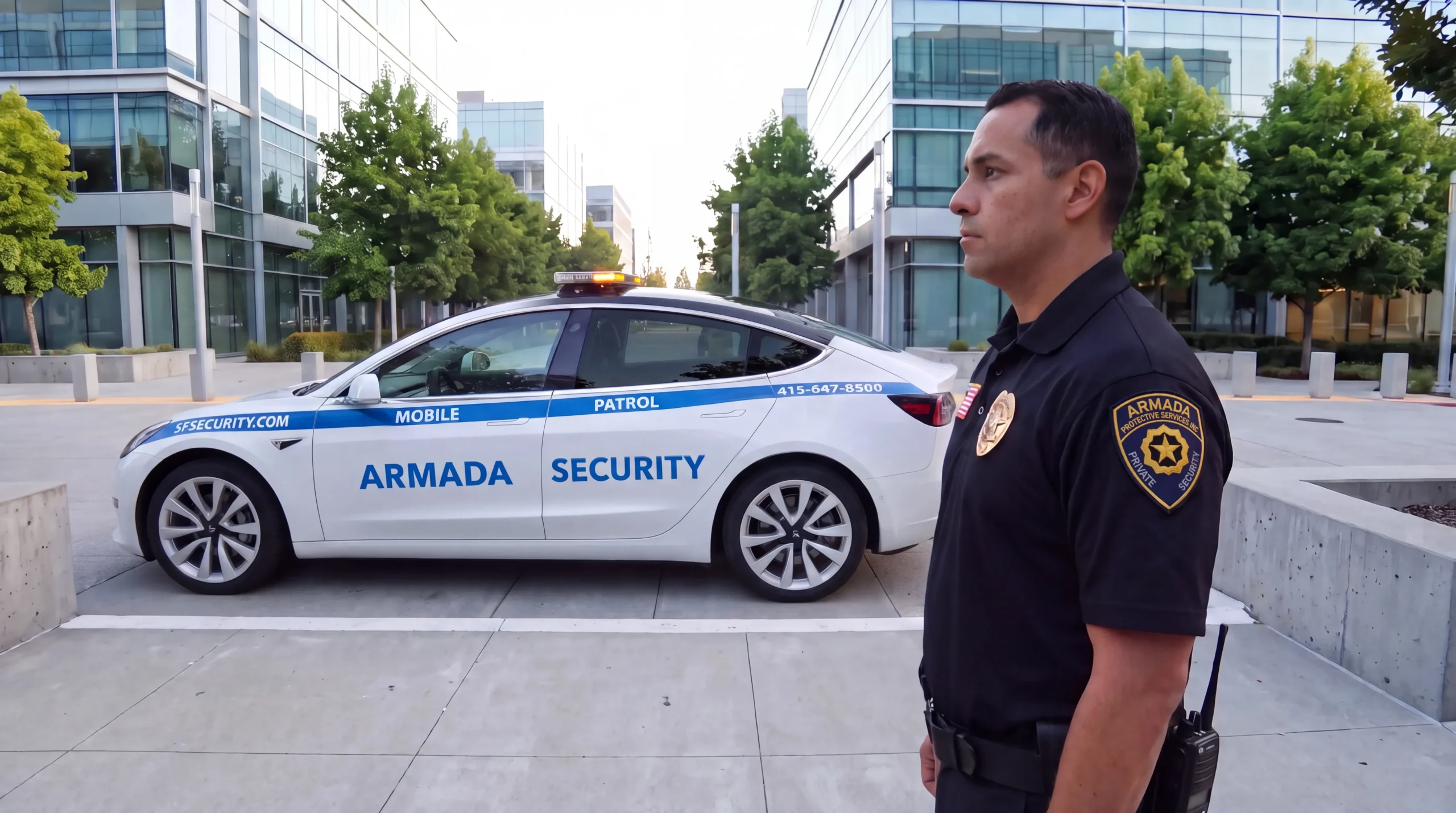
Police triage by call priority. A violent crime outranks a tripped alarm, a tent against your loading door, or someone in the back lot at three in the morning. Those are Priority C calls, and the city publishes what they wait.
In the Tenderloin the median is 99 minutes from the 911 call to the first unit on scene, measured on 13,500 calls (source: Law Enforcement Dispatched Calls for Service4, DataSF). Armada reaches a client site in 15 to 30 minutes.
Priority C calls only, with onview calls excluded. The multiple is against the slow end of Armada’s window.
What this means if you are taking space here
The numbers above describe the district. They do not describe your address, and two buildings on the same block are not the same risk. What the data does tell you is which questions to ask before you sign.
The entrance is the exposure
With cleaning and encampment cases running as they do, the doorway and the setback are where your morning goes. Ask who clears it, and at what hour.
Count the hours the building is empty
Burglary and theft reports cluster in the hours nobody is there. Your lease hours and your alarm response window have to line up, which is what alarm response is sized against.
Find the blind spots, not the cameras
A camera count is not coverage. Loading areas, rear access and side approaches are what matters, and the coverage models differ exactly there.
Know who answers at three in the morning
If the answer is 911 alone, the figure above is your wait. What a visit costs, and what moves it, is set out on the pricing page.
Sources and dates
All figures cover 15 September 2025 to 14 September 2026 and come from the City and County of San Francisco’s own open data. Every dataset below is public: you can check any number on this page yourself.
- Business mix
Registered Business Locations1, locations with no closing date on record.
- Street cases
SF 311 Cases2, all case types, shown as shares of the district total.
- Incidents
Police Department Incident Reports3. Drug offenses, warrants, missing persons and administrative categories are left out of our table; they are in the dataset and they are not events at a business address.
- Police arrival
Law Enforcement Dispatched Calls for Service4, Priority C calls handled by SFPD units, excluding calls an officer opened while already on scene. Measured from the 911 call to the first unit on scene.
On this method the citywide median is 75 minutes, against the 74.4 minutes the city itself publishes for June 2026 (source: Law Enforcement Dispatched Calls for Service4, DataSF): the two agree, which is how we know the method is the city’s own. Figures are refreshed monthly.
Our Statistics. Your Guarantee.
A district profile is only worth reading if the figures in it can be re-counted, which is why every number above names the dataset it came from. Officers are licensed one at a time through BSIS and background-checked before a first shift, and Armada Protective Services has held California PPO 120526 since 1994. Armada has been the top-rated San Francisco security company since 2021 according to SFist5. Every outside document named on this page was checked November 2026.
- 2x
At least twice as fast as police arrival
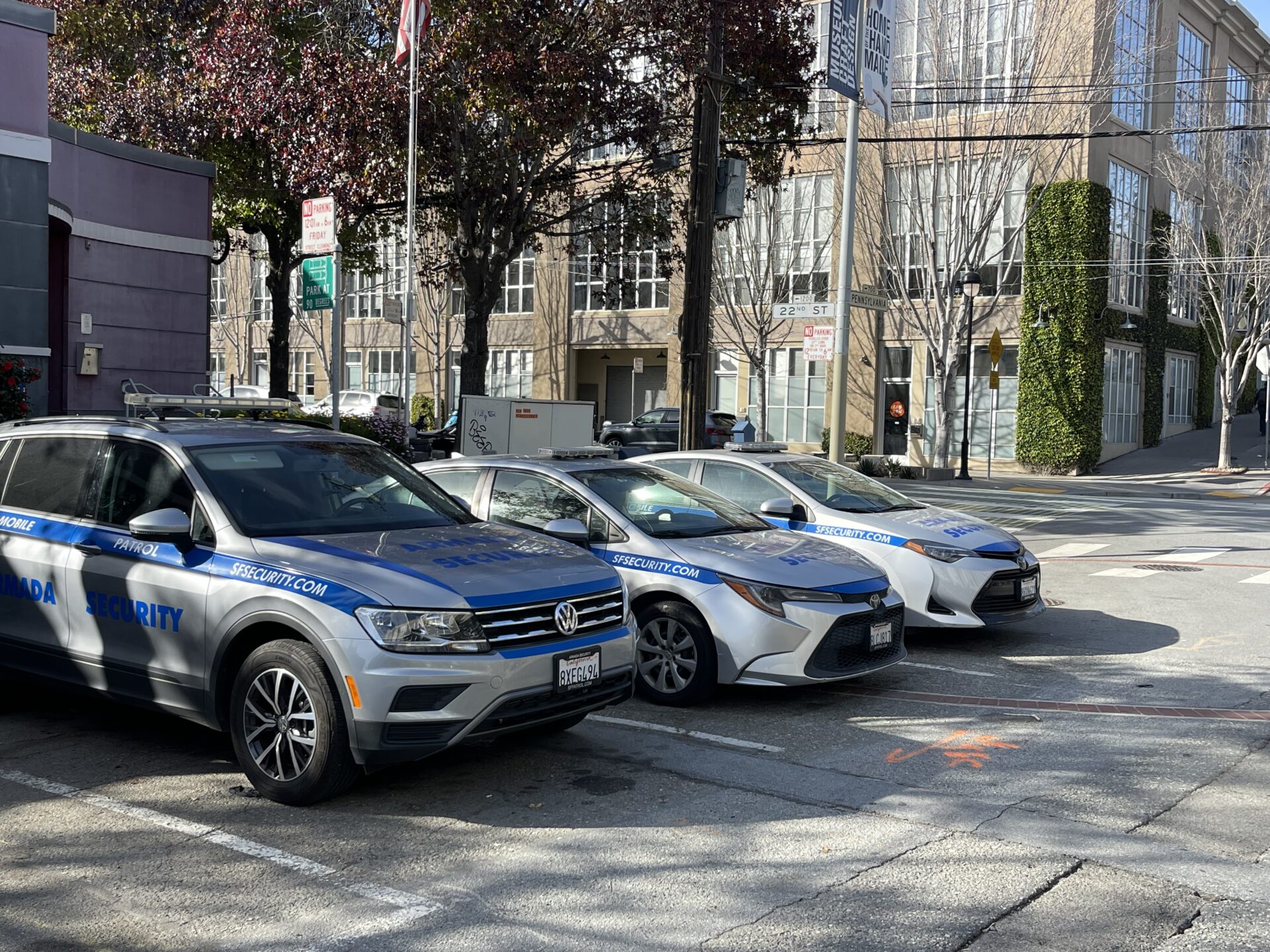
Under contract Armada is on site in 15 to 30 minutes. The median SFPD publishes for a low-priority call is longer, which is why SFPD itself points businesses to private security for anything short of a crime in progress.
- 80%
Fewer incidents at monitored properties
Twelve client sites kept incident records both before and after Armada started. Across them incidents fell by 80 percent. 2025 client survey.
- 24/7
Your officer is the one you call
Clients hold the direct numbers of the officers on their site, and the app carries the messages, the photos and the log. Nothing is relayed through a desk.
- 100%
Licensed and insured
Every officer individually BSIS licensed and background-checked, under California Private Patrol Operator PPO 120526, both verifiable in the state register.
Customer testimonials
Professional and Reliable Security Services in the Bay Area
We hired Armada on short notice for a situation we were experiencing in one of our apartment complexes. They responded quickly, set up patrols and a guard service for us very quickly. Guards were professional, prompt and communicated activity at the property to us.

Lana August
Property Manager, San Francisco
We have used Armada for about 10 years. They are an amazing company providing professional personnel consistently. Thank you Armada!

Jesse Leite
Resident Manager, San Francisco
Every Armada employee with whom I've had the pleasure of interacting has been top notch - curteous, efficient, effective, knowledgeable, responsible.

Alex Goretsky
Business Owner, San Francisco
I Manager a portfolio of communities in San Francisco -working with Armada is great. They are flexible, honest and the Guards are always on point. I would recommend this firm to other HOA/Commercial managers.

Christopher Stanley
Owner and Chief Executive Officer, San Francisco
Quoted verbatim from published client reviews, including their original wording.
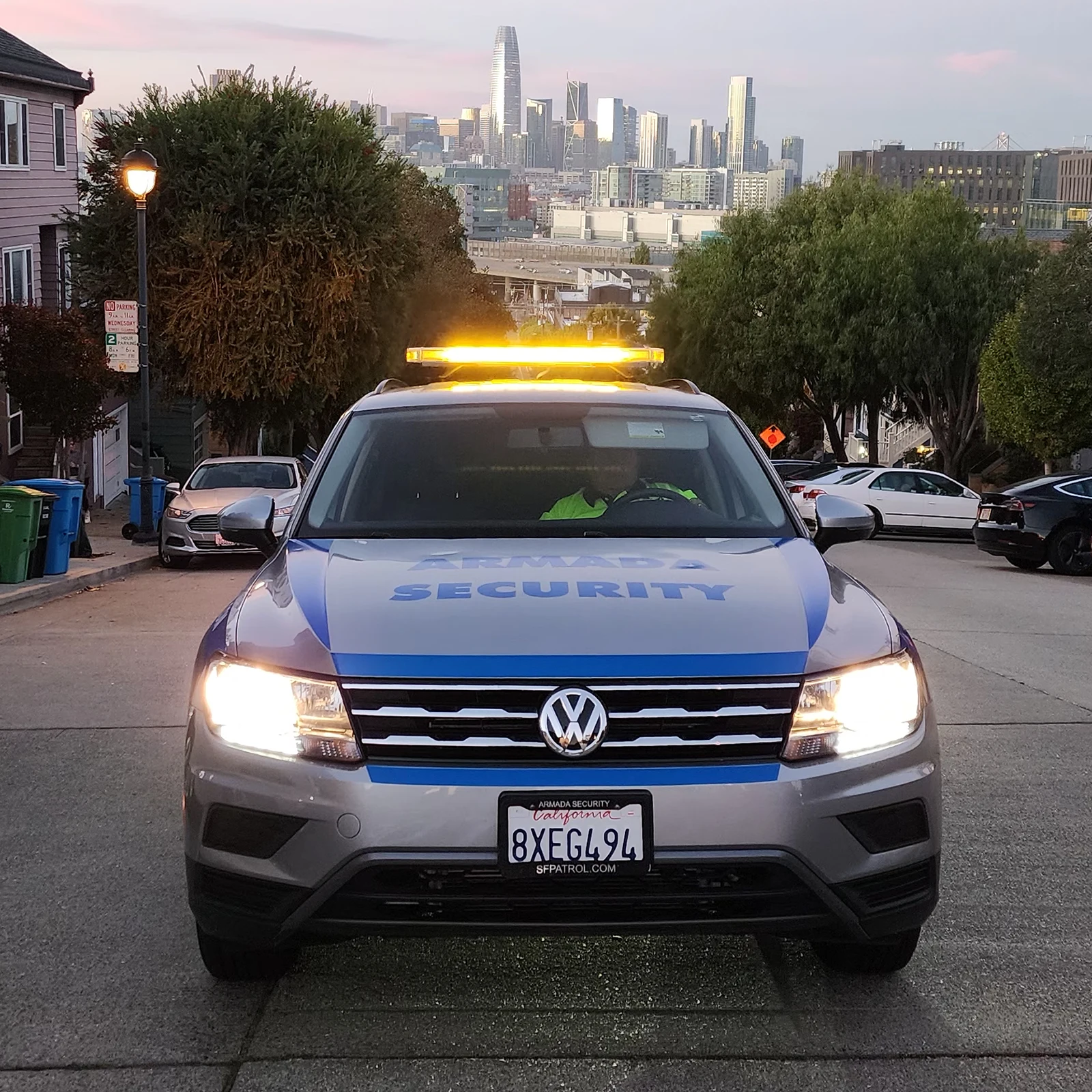
We will look at the address with you
If you are buying a business or taking a building here, we will walk the site and tell you what we see: entry points, access control, camera coverage and its gaps, lighting, the loading area, and the hours the place is exposed. You get a written list of what is open and what it takes to close it, and we do not tell you whether to sign; that is your call. Buyers who cannot travel use this most: we are the eyes on the ground before the money moves. The site visit is free, the minimum term is one month and the agreement runs month-to-month after that. The on-site visit is for whoever controls the premises; if the building is managed for you, we will send this district report instead, with what to ask your building manager for.
FAQs
What buyers and tenants ask us after they have read the district’s own figures.
Does a Tenderloin address mean I need an officer on post around the clock?
Usually not. The figures on this page describe forty blocks, not your doorway, and the hours that are actually exposed are rarely the whole day. The visit counts those hours first; the comparison of coverage models is what settles whether a post, a patrol or a mechanical fix answers them.
What can a guard do about encampment and street cleaning cases?
An officer can keep the entrance and the setback usable, speak to people before the day starts, and write down what was found with a time and a photograph. What an officer cannot do is clear a sidewalk the city clears, so the useful question at the visit is who does that and at what hour.
Why do you print the police figure at all if you are selling against it?
Because it is published and anyone can check it, and because the useful part is not the number but the method: Priority C, measured from the 911 call to the first unit on scene. Print the method and the figure can be argued with. Print neither and you are asking to be believed.
Are these numbers kept up to date?
They are refreshed monthly from the four datasets named at the foot of the page, over a rolling twelve-month window. If a figure here disagrees with the city’s portal, the portal is right and we have not caught up yet.
Do you cover the rest of the city on the same method?
Yes. Each San Francisco district page carries its own figures counted the same way, and the full list of areas says which ones have their own page. Cities outside San Francisco are not given these figures, because they are policed by other agencies.
Ask us directly
If your question is about one address in this district rather than about the district, send it here and an expert will answer it.
Sources
Where the figures, rules and local facts on this page come from. Links reviewed 6 Nov 2026.
- City and County of San Francisco open data 1 Registered Business Locations, 2 SF 311 Cases, 3 SFPD Police Department Incident Reports, 4 Law Enforcement Dispatched Calls for Service
- SFist 5 Armada Protective Services — San Francisco’s Top Security Company trade press, used only where no primary source carries the claim