Seven questions, then a recommendation that shows its working
Nothing here is sent anywhere and no contact details are asked for. The logic is fixed and printed in full, so the same answers always reach the same conclusion, including the conclusions that point away from buying coverage.
- Seven questions about the property, answered by you and kept by you
- Eight rules in order, each with its reasoning and its caveats
- One of five conclusions, one of which is to buy nothing yet
Checking the answer on site costs nothing, and the written assessment belongs to you afterwards.
If it is urgent, call (415) 647-8500

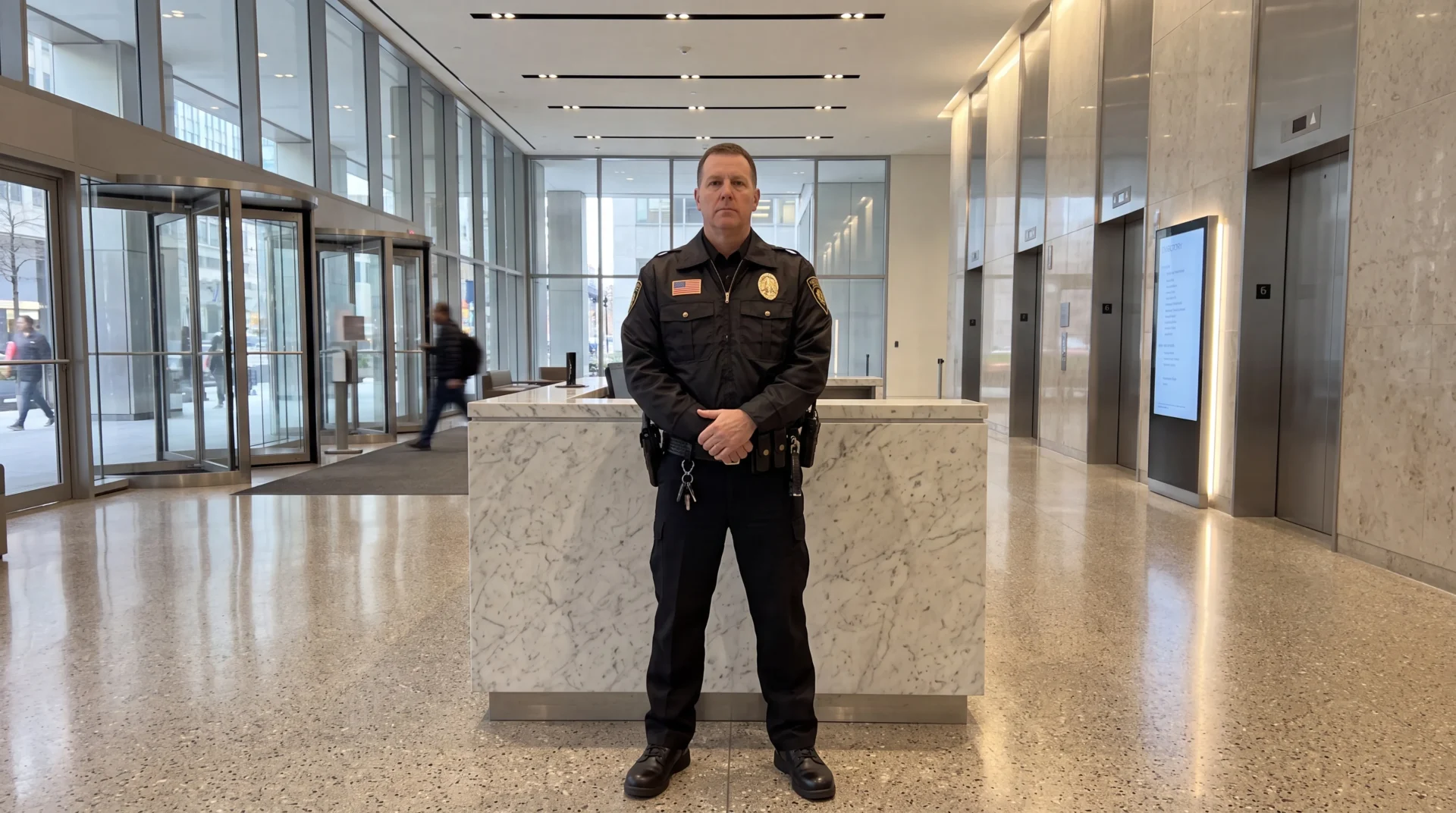
What this tool is, and what it will not do
A coverage selector is a fixed set of questions about a property whose answers map to one coverage model through stated rules, so the reasoning can be checked instead of trusted.
Answer the seven questions below about your own property, then read the rules in order. The first rule whose conditions match your answers is the recommendation, and the rules under it do not apply. Every conclusion this logic can reach is printed on this page with its reasoning and its caveats.
- A standing officer at the point of contact, including a fire watch.
- Event or short-term staffing for a fixed date.
- Mobile patrol with logged checkpoints.
- A short post over the risk window with patrol for the rest.
- No ongoing security contract yet.
- Cameras alone are never the conclusion here. They document and do not intervene, so they belong alongside personnel rather than instead of them.
The table of the same five models, compared factor by factor rather than by question, is on the coverage comparison page, and what each one costs to run is on the pricing page.
Seven questions about the property and the problem
Write your seven answers down. The rules in the next section read them in this order.
- Q1. Occupancy
Is the property occupied during the hours you are worried about?
- Yes, people are there.
- No, it is empty then.
- The property is vacant entirely.
- Q2. The issue
What is actually happening?
- People getting in, or through, where they should not.
- Theft or property loss.
- Vandalism or damage.
- A fire system is impaired and a watch is required.
- A one-off event needs staffing.
- Nothing yet, this is precautionary.
- Q3. The window
When does it happen?
If you do not know yet, say so, finding the window is usually the first thing worth doing.
- A predictable window of a few hours.
- Overnight, broadly.
- Throughout the day.
- No clear pattern yet.
- Q4. Points
How many separate places on the property need attention?
- One, an entrance or a single area.
- A handful across the site.
- Many, or several properties.
- Q5. Interaction
Does someone need to interact with people on site?
Admitting visitors, badging contractors, turning people away, holding a gate.
- Yes, access control or direct contact is required.
- No, checking and documenting is enough.
- Q6. The gap
Is there a known physical or procedural gap you have not fixed?
A broken gate or latch, unlit area, shared codes, missing signage, no trespass authorization.
- Yes, there is something unfixed.
- No, that side is in order.
- Not sure.
- Q7. Duration
How long do you expect to need coverage?
- A single date or a few days.
- Weeks to a few months.
- Ongoing.

Eight rules, read top to bottom, first match wins
Each rule states the answers that select it, what it concludes, why, and what would change the answer. Stop at the first rule that matches you.
- If Q6 says there is something unfixed, this caveat is added to whatever the rules below conclude: you have identified an unfixed physical or procedural gap. Fix it first, a latch, a light, a code rotation or a trespass authorization is often cheaper than one month of coverage and permanently effective. Security coverage layered over an open gate becomes indefinite.
- Rule 01
Fire system impaired. You need a fire watch, not a coverage decision
Reached when Q2 says a fire system is impaired and a watch is required.
A licensed guard assigned to one post for a defined shift, continuous presence at one location.
Why
- An impaired fire alarm, sprinkler or standpipe system requires assigned personnel conducting documented rounds until the system is restored.
- This is a compliance requirement set by your authority having jurisdiction, not a coverage preference, and the round interval and log format are theirs to specify.
What could change this answer
- Confirm the required round interval with the AHJ in writing before coverage starts.
- Fire watch personnel cannot also hold another post. The watch is the whole assignment.
How that service works: Fire watch.
- Rule 02
One-off event, or a few days. This is event or short-term staffing, not an ongoing coverage model
Reached when Q2 says a one-off event needs staffing, or Q7 says a single date or a few days.
A licensed guard assigned to one post for a defined shift, continuous presence at one location.
Why
- Fixed-date work is staffed from the run of show: load-in, doors, peak, close and load-out each need different positions and headcount.
- A flat headcount across the day overpays through the quiet hours and leaves the peak short.
What could change this answer
- Confirm whether your venue permits an outside security contractor before soliciting bids.
How that service works: Event security.
- Rule 03
No pattern, no gap. There may not be a security problem to buy yet
Reached when Q2 says nothing has happened yet, Q3 says no clear pattern, and Q6 says nothing is unfixed.
A physical or procedural fix resolves the issue without a recurring security contract.
Why
- With no incident pattern and no identified gap, coverage bought now would be sized by guesswork and is likely to be either wasted or misdirected.
- A site assessment costs you nothing and produces the pattern that would size the coverage correctly.
What could change this answer
- If this is driven by an insurance or lender condition rather than an incident, say so, because the requirement, not the risk, sets the coverage.
This rule sells nothing. The next step is the free site assessment, not a quote.
- Rule 04
Vacant, nobody to handle. Mobile patrol with logged checkpoints
Reached when Q1 says the property is vacant entirely and Q5 says checking and documenting is enough.
A vehicle unit visiting on a schedule or at randomized intervals, logging GPS-stamped checkpoints each visit.
Why
- A vacant property does not justify continuous presence. Randomized patrol visits with interior and exterior checkpoints produce a dated condition record on every visit.
- Many vacancy insurance endorsements carry an inspection condition. A timestamped, positional checkpoint log is the document that satisfies it, and a specimen patrol report shows what one looks like.
What could change this answer
- Patrol will find building conditions, water intrusion, an open utility, a forced door, as often as it finds people. Make sure the reporting path for those reaches whoever can act.
How that service works: Mobile patrol.
- Rule 05
Contact needed, one place. A standing officer at the point of contact
Reached when Q5 says access control or direct contact is required and Q4 says one entrance or a single area.
A licensed guard assigned to one post for a defined shift, continuous presence at one location.
Why
- Access control and direct contact with people require a person at the point. Patrol cannot staff a lobby, badge a visitor or hold a gate.
- With attention needed at one location, a standing post is the proportionate answer.
What could change this answer
- If Q3 says a predictable window of a few hours, size the post to that window. A twelve-hour shift bought to cover a two-hour problem is the overspend this question exists to prevent.
How that service works: Standing security officers.
- Rule 06
Contact needed, several places, narrow window. A short post over the window, patrol for the rest
Reached when Q5 says contact is required, Q4 says more than one place, and Q3 says a predictable window of a few hours.
A short post over the concentrated risk window, with patrol passes covering the remaining hours.
Why
- Two requirements are in tension: someone must be present where people are handled, and several other points need checking.
- A short post over the known window plus patrol passes across the remaining hours covers both without staffing every point.
What could change this answer
- This only stays economical while the window remains narrow. Re-check the incident pattern once two months of checkpoint log exist.
How that service works: standing security officers and mobile patrol on one account.
- Rule 07
Contact needed, several places, no window. A post where people are handled, patrol everywhere else
Reached when Q5 says contact is required, Q4 says more than one place, and Q3 gives no predictable window.
A short post over the concentrated risk window, with patrol passes covering the remaining hours.
Why
- You need presence for access control and coverage across multiple points. Staffing every point is rarely proportionate.
- A post where people are handled, with patrol covering the remaining exposures, is the usual resolution. A worked example works through one building of this shape.
How that service works: standing security officers and mobile patrol on one account.
- Rule 08
Everything else. Mobile patrol with logged checkpoints
Reached when no rule above matches: Q5 says checking and documenting is enough, and the property is not vacant.
A vehicle unit visiting on a schedule or at randomized intervals, logging GPS-stamped checkpoints each visit.
Why
- Nobody needs to be handled on site, the requirement is deterrence and a record. That is what patrol does well.
- Randomized visits remove the predictable safe window, and each visit produces a GPS-stamped checkpoint record you can read yourself.
- If Q4 says many, or several properties: checkpoint sets per site give you comparable reporting across the whole portfolio.
What could change this answer
- If Q3 says no clear pattern yet: the pattern is not established yet. Start with broader coverage and reduce it once the log shows when incidents actually occur, not the other way around.
- If Q2 says theft or property loss: if losses show no forced entry and no time pattern, the cause is more often keys, codes or an internal process than an outside intruder. Patrol will not resolve that.
How that service works: Mobile patrol.
Our Statistics. Your Guarantee.
A selector is worth no more than the record behind the people it sends, so the four figures Armada stands on are printed here with what each was measured against. Officers are licensed one at a time through BSIS and background-checked before a first shift, and Armada Protective Services has held California PPO 120526 since 1994. Armada has been the top-rated San Francisco security company since 2021 according to SFist1. Every outside document named on this page was checked November 2026.
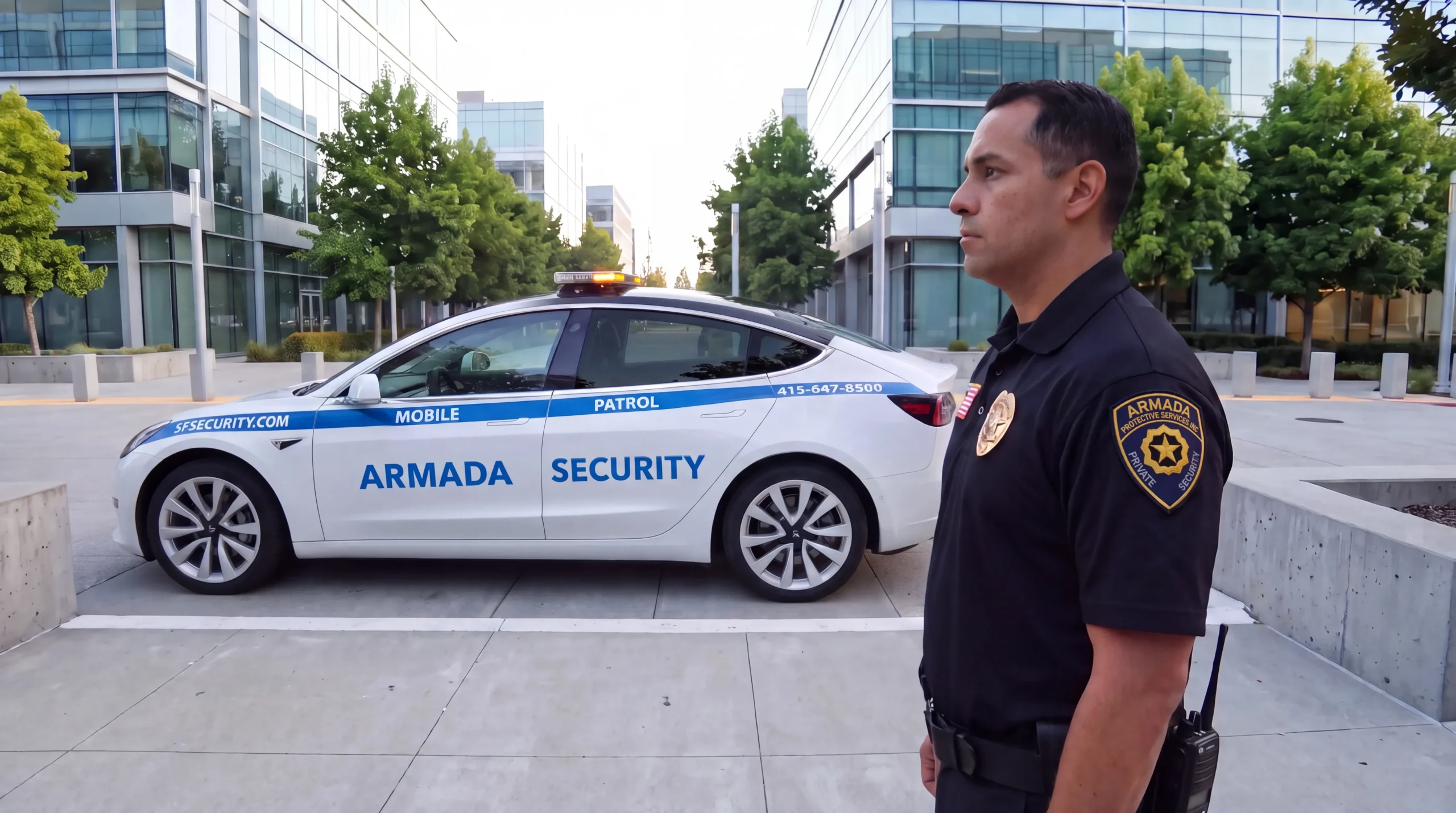
- 2x
At least twice as fast as police arrival
Under contract Armada is on site in 15 to 30 minutes. The median SFPD publishes for a low-priority call is longer, which is why SFPD itself points businesses to private security for anything short of a crime in progress.
- 80%
Fewer incidents at monitored properties
Twelve client sites kept incident records both before and after Armada started. Across them incidents fell by 80 percent. 2025 client survey.
- 24/7
Your officer is the one you call
Clients hold the direct numbers of the officers on their site, and the app carries the messages, the photos and the log. Nothing is relayed through a desk.
- 100%
Licensed and insured
Every officer individually BSIS licensed and background-checked, under California Private Patrol Operator PPO 120526, both verifiable in the state register.
Customer testimonials
Professional and Reliable Security Services in the Bay Area
We hired Armada on short notice for a situation we were experiencing in one of our apartment complexes. They responded quickly, set up patrols and a guard service for us very quickly. Guards were professional, prompt and communicated activity at the property to us.

Lana August
Property Manager, San Francisco
We have used Armada for about 10 years. They are an amazing company providing professional personnel consistently. Thank you Armada!

Jesse Leite
Resident Manager, San Francisco
Every Armada employee with whom I've had the pleasure of interacting has been top notch - curteous, efficient, effective, knowledgeable, responsible.

Alex Goretsky
Business Owner, San Francisco
I Manager a portfolio of communities in San Francisco -working with Armada is great. They are flexible, honest and the Guards are always on point. I would recommend this firm to other HOA/Commercial managers.

Christopher Stanley
Owner and Chief Executive Officer, San Francisco
Quoted verbatim from published client reviews, including their original wording.
Have the answer checked on site
What these rules produce is a starting position, not a quote. What changes it most often is the incident pattern, which is also what actually moves the cost. The site visit is free and worth doing before anyone quotes a price, the minimum term is one month, and the agreement runs month-to-month after that.
FAQs
What people ask after they have run their own property through the eight rules.
Does this tool send my answers to you?
No. There is no form here, no field stores anything and no contact details are asked for. The seven answers stay with you; what you bring to a conversation afterwards is your own note of which rule matched.
Two rules seem to describe my property. Which one applies?
The higher one. The rules are read top to bottom and the first match wins, which is why the fire watch and the fixed-date rules sit above the rest: when either is true, the rest of the reasoning does not get to argue with it.
Rule 03 told me to buy nothing. Is that a real answer?
It is, and it is the reason the logic is printed rather than hidden. With no incident pattern and no unfixed gap, coverage bought now is sized by guesswork. The free site visit is still worth taking, because it produces the pattern that would size it properly later.
The tool says patrol, but my insurer is asking for something specific.
Then the requirement sets the coverage, not the risk. Bring the wording to the visit; an inspection condition on a vacancy endorsement, for example, is usually satisfied by a timestamped checkpoint log rather than by a standing post.
How far is this from an actual price?
One step. The rules pick the shape of the coverage; the hours, the points and the site conditions set the number, and those come from the visit. The ten things that move the number are set out on the pricing page.
Ask us directly
If two rules still seem to fit your property, send the seven answers here and an expert will tell you which one governs and why.
Sources
Where the figures, rules and local facts on this page come from. Links reviewed 5 Nov 2026.
- SFist 1 Armada Protective Services — San Francisco’s Top Security Company trade press, used only where no primary source carries the claim