Corporate Event Security in San Francisco
Officers for conferences, product launches, offsite meetings and company parties in a rented space, where the guest list is your own staff, your customers and the press.
A corporate event runs on a schedule somebody already published. Registration opens at eight, the first session starts at nine, exhibitors are still unpacking at the back of the hall, and by six the same room is a reception with a bar in it. Armada staffs the badge desk, the floor and the back of house with BSIS licensed officers, and each post order is written from your run of show and from the house rules of the building you rented.
Free site visit first: we walk the registration area, the hall and the loading dock with your event lead, then write the post orders and the price.
If it is urgent, call (415) 647-8500

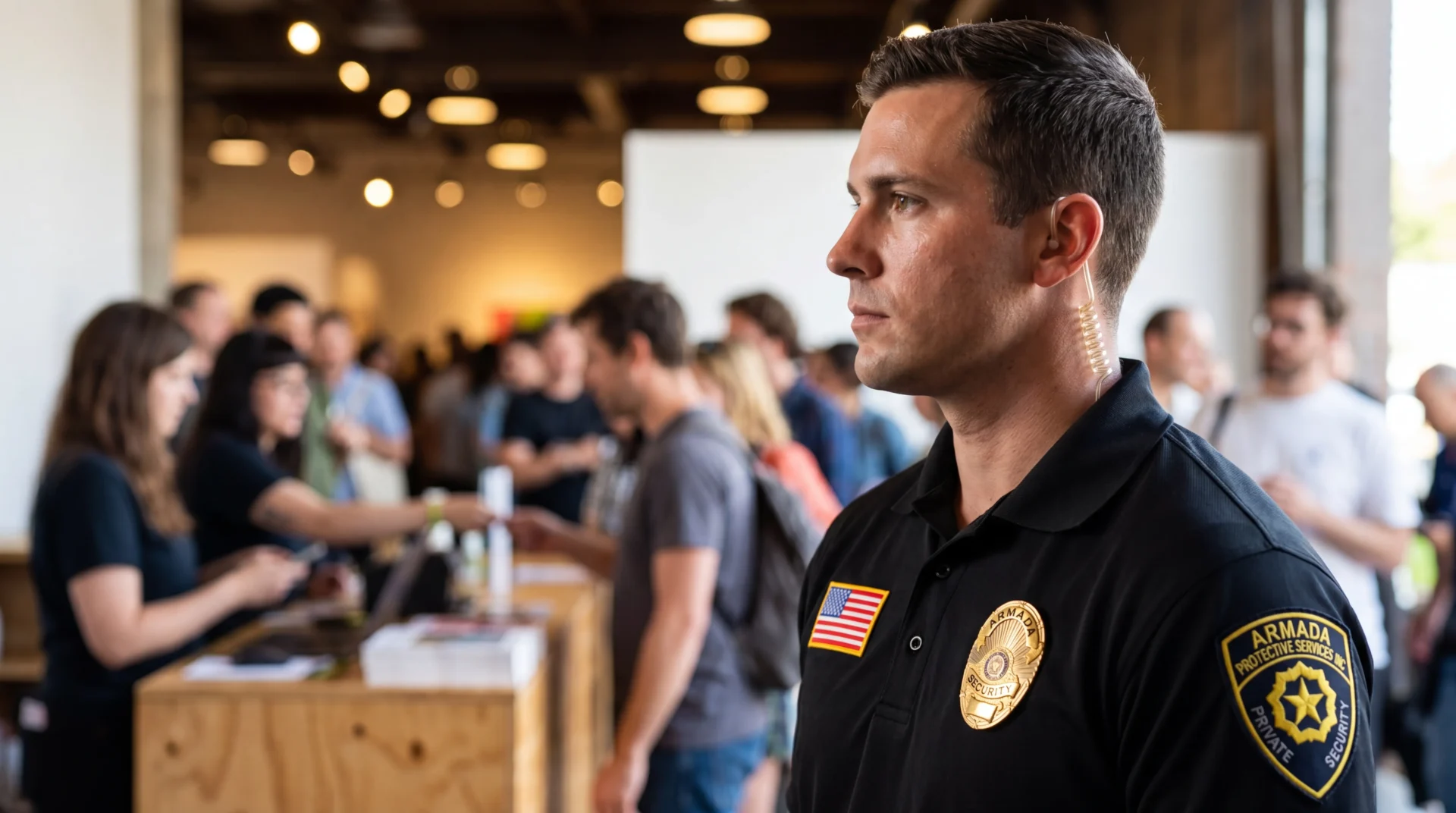
What a company event brings into a building you rented
A conference, an offsite or a launch puts your own staff, the customers and press you invited, and the contractors who build the room at one address on the same morning. Nobody is holding a ticket, and the three of them need three different doors.
The badge desk is the whole door policy
Your list arrives as an export and keeps changing until the first session starts, so the desk is where the day is held or lost.
- Badges are printed and handed over at a staffed desk, never left out in rows on a table for the early arrivals to sort through.
- Walk-ups, substitutions and the name spelled wrong go to one supervisor, so the queue behind them keeps moving.
- What each color of badge opens is agreed before doors: the hall, the breakout rooms, the speaker room, the floor during build.
- The desk keeps a running count, because your caterer and the building both work from that number rather than from the invitation list.
Exhibitors leave the expensive part on the floor
Between build and teardown your hall holds demo hardware, prototypes and laptops that belong to other companies.
- The dock is staffed from the first truck to the last case, because that door stands open to the street for hours.
- Stands are walked overnight between show days, when the hall is dressed and empty and the building has gone home.
- What leaves is checked against what came in, by the officer who watched it arrive rather than by the person carrying it.
- Anything found loose at close goes to one locked room and onto the log, so a missing laptop has a time and a place attached to it in the morning.
The guest list is not the whole guest list
An event announced to your customers was announced to everybody else who reads your announcements.
- Press and analysts are badged apart from the trade, and somebody on your side is named as the person they are handed to.
- Recruiters, resellers and competitors work a floor the way exhibitors do, and a badge that does not match the person wearing it is the first thing a door officer reads.
- A guest who should not be in the room is taken out of it before anything is discussed, and what was said goes into the log with the time.
- Rooms the company closed stay closed: the speaker room, the production office and whatever floor the building gave you for the day.
The reception is a second event in the same room
At six the session room becomes a bar, the badges come off, and an hour later the whole building leaves at once.
- The bar, the coat check and the elevator lobby get posts of their own once the sessions close.
- Officers and bar staff agree one signal before doors, so a guest who has had enough is slowed down by the person pouring rather than confronted in front of your customers.
- Executives, the people you put on stage and anyone the company made visible that week are covered by name rather than by job title.
- Rides are called to one named corner, and the last sweep of the room looks under the chairs before the lights go down.
Halls, ballrooms and offices we staff
Convention floors and exhibition halls, hotel ballrooms booked for a day, a rented loft for a launch, a campus auditorium on the Peninsula, and your own office after hours. Each one hands you a different dock, a different lobby and a different set of house rules.
We serve: San Francisco, San Mateo, Brisbane and San Jose (see all locations)
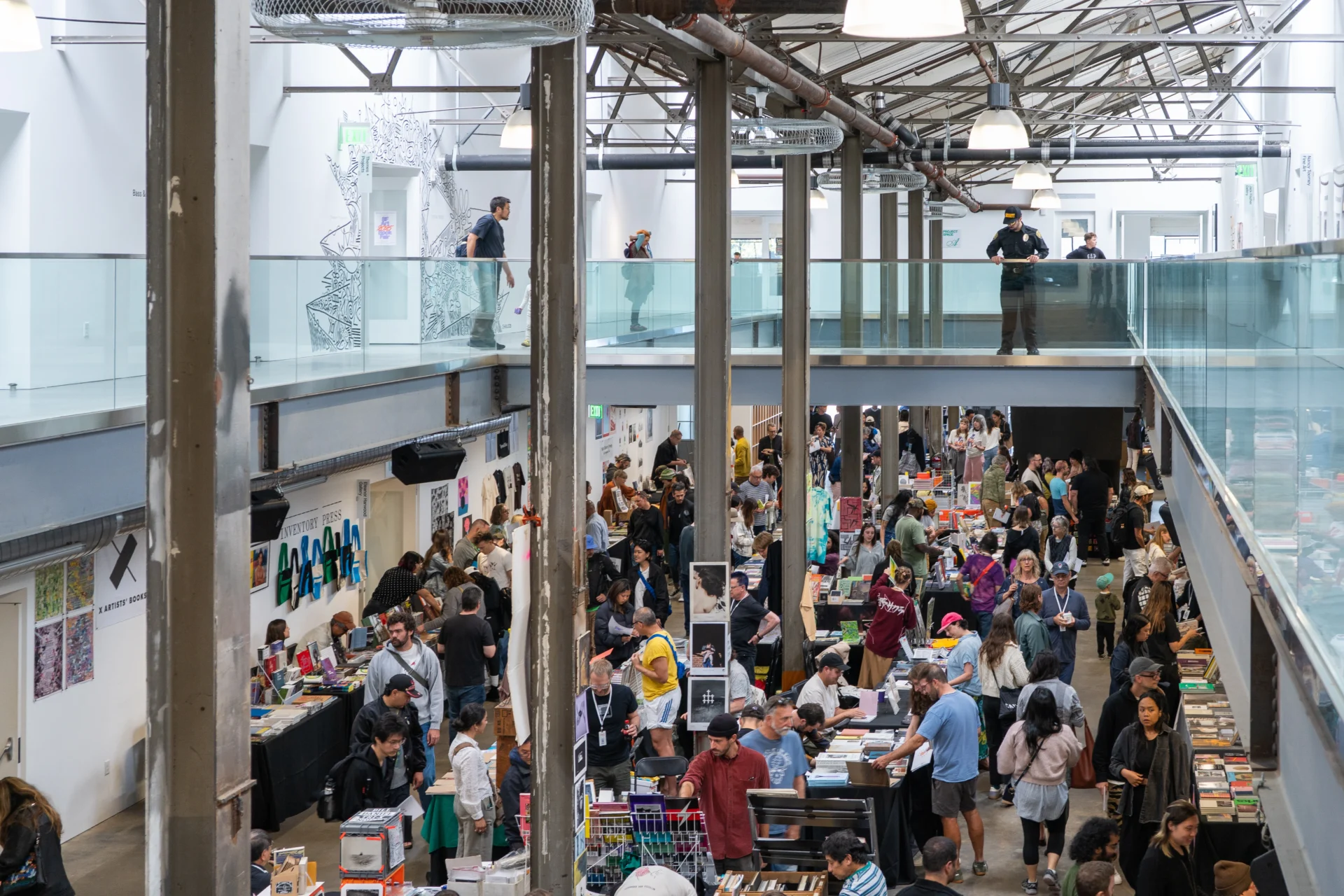
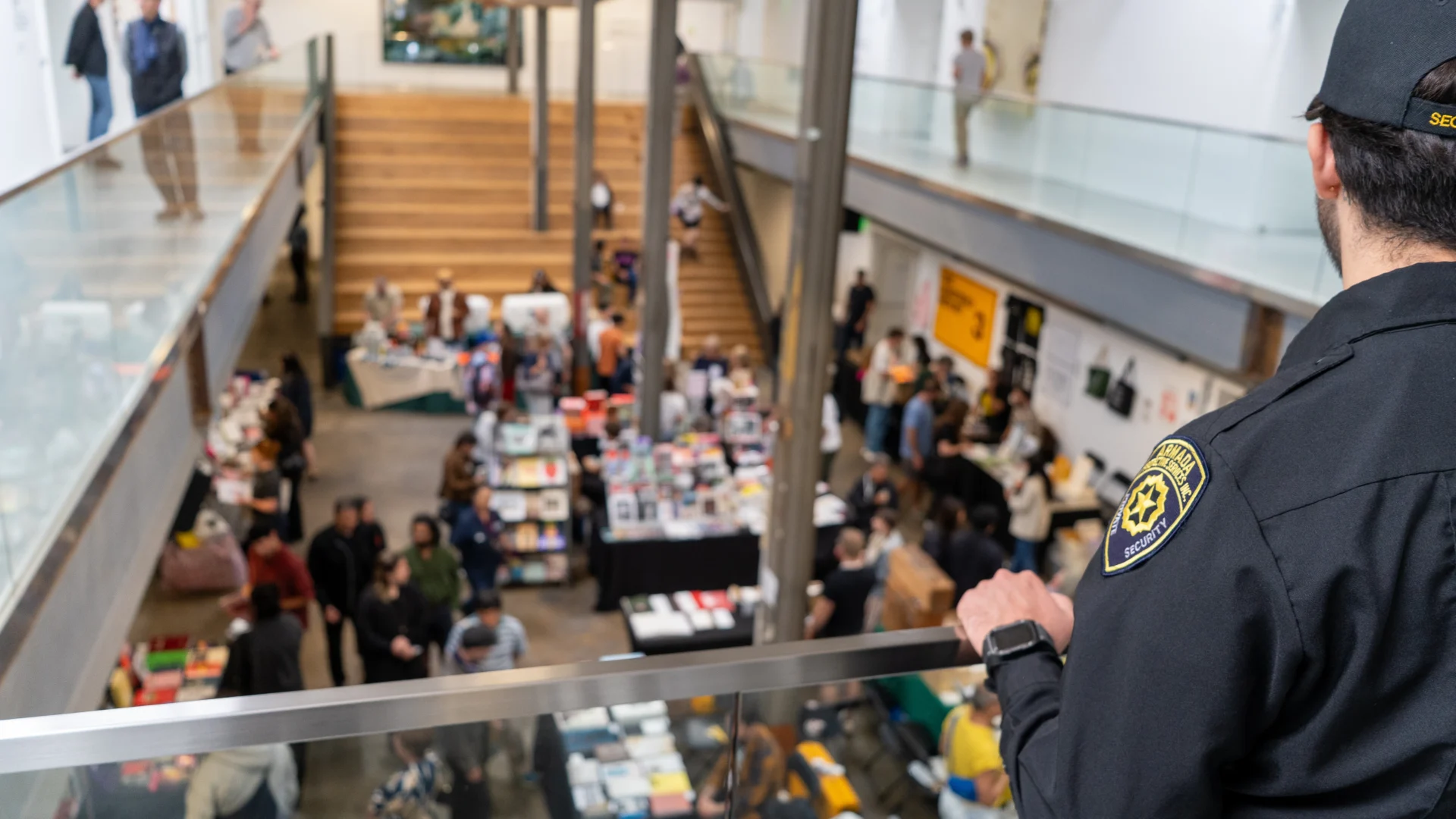
How a conference day is staffed
Planning starts from your run of show and the floor plan of the building: build, registration, the first session, the floor, the reception, teardown. Each position gets a written order.
Armada staffs events and sells no hardware. Where a hall needs more light over the dock or a camera on the store room, we write that down for you and for the venue, and the contractor who installs it is somebody else.
The desk, the floor and the back of house are three jobs
One crowd, three permissions, and the difference between them is a line in a post order.
- Registration is staffed by officers who know what each badge opens, with the list of exceptions on paper at the desk.
- The hall is walked rather than watched from a corner, on a round that takes in the stands, the store room and the fire exits.
- Speaker rooms, the production office and the dock are separate posts with separate lists, because the people allowed into them are not the same people.
The building already has a plan, and we work to it
Your event is a guest at somebody else’s address, and that address was given rules by the city long before you booked it.
- A building with a Group B occupancy needs a fire safety and evacuation plan once its occupant load reaches 500, or once more than 100 people are above or below the level of exit discharge, according to section 403.3 of the California Fire Code. 1
- Officers walk the exits, the refuge areas and the assembly point before the first guest arrives, so nobody is reading a floor plan with a room behind them.
- The house manager, the building engineer and our supervisor meet at build, and a change to the run of show reaches the post orders the same morning.
One supervisor, one number
Your event lead should be talking to one person all day, and so should the venue.
- The named supervisor handles the building, the contractors and the police, and you hold his number from build to teardown.
- The shift runs on earpieces and short written messages, so nothing is said over an open radio while somebody is on stage.
- Calling the police is the supervisor’s decision, taken against the plan rather than invented at the door.
What you can show afterwards
A company event is written up internally the next morning, and that write-up is only as good as what somebody recorded at the time.
- Every refusal, removal, medical call and police contact is logged with the time, the place in the building and what was done.
- A private patrol operator has to send the Bureau of Security and Investigative Services a written report within seven business days of a physical altercation with a member of the public, according to Business and Professions Code section 7583.2. 2
- The certificate your venue asks for names the policy the state defines for a private patrol operator, carrying minimum limits of $1,000,000 for any one loss or occurrence, according to Business and Professions Code section 7583.40. 3
- The shift report reaches you about an hour after the last officer stands down.
Our Statistics. Your Guarantee.
A conference is contracted months ahead and judged on the one morning it happens, so the company standing at your badge desk should be checkable before the purchase order goes out. Armada has been the top-rated San Francisco security company since 2021 according to SFist4. Each figure below says what it is measured against.
- 2x
At least twice as fast as police arrival
Under contract Armada is on site in 15 to 30 minutes. The median SFPD publishes for a low-priority call is longer, which is why SFPD itself points businesses to private security for anything short of a crime in progress.
- 80%
Fewer incidents at monitored properties
Twelve client sites kept incident records both before and after Armada started. Across them incidents fell by 80 percent. 2025 client survey.
- 24/7
Your officer is the one you call
Clients hold the direct numbers of the officers on their site, and the app carries the messages, the photos and the log. Nothing is relayed through a desk.
- 100%
Licensed and insured
Every officer individually BSIS licensed and background-checked, under California Private Patrol Operator PPO 120526, both verifiable in the state register.
Related Security Services
The other kinds of event Armada staffs, besides conferences and company gatherings.
Officers for weddings, anniversaries, birthdays and company parties held in a private home, a rented house or a room booked for one night.
Officers for street fairs, parades, rallies and park festivals, where entry is free and the edge of the site is a public street.
Licensed officers for entry queues, artist areas and cash points at concerts and festivals.
Customer testimonials
Professional and Reliable Security Services in the Bay Area
We hired Armada on short notice for a situation we were experiencing in one of our apartment complexes. They responded quickly, set up patrols and a guard service for us very quickly. Guards were professional, prompt and communicated activity at the property to us.

Lana August
Property Manager, San Francisco
We have used Armada for about 10 years. They are an amazing company providing professional personnel consistently. Thank you Armada!

Jesse Leite
Resident Manager, San Francisco
Every Armada employee with whom I've had the pleasure of interacting has been top notch - curteous, efficient, effective, knowledgeable, responsible.

Alex Goretsky
Business Owner, San Francisco
I Manager a portfolio of communities in San Francisco -working with Armada is great. They are flexible, honest and the Guards are always on point. I would recommend this firm to other HOA/Commercial managers.

Christopher Stanley
Owner and Chief Executive Officer, San Francisco
Quoted verbatim from published client reviews, including their original wording.
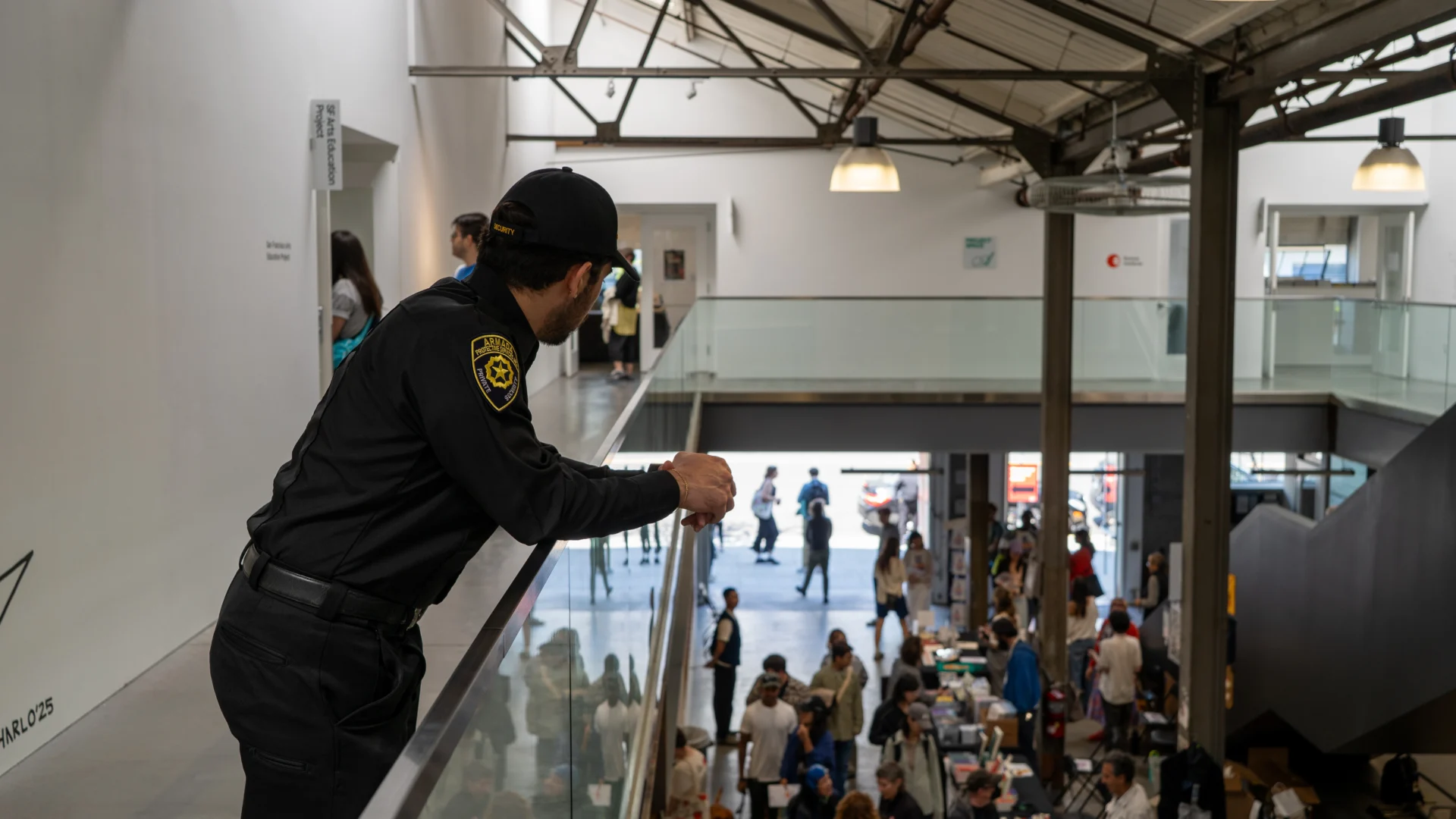
Send us the run of show
Tell us the dates, the venue and how many people you expect through the door. One of our people walks the registration area, the hall and the dock with your event lead, writes the post orders against what the building already requires, and prices the days before you commit to anything.
Corporate event security FAQs
What event leads, office managers and marketing teams in San Francisco ask us before the officers are booked.
Our own employees already check badges at the door. Do we need licensed officers at all?
For your own event, in your own name, your staff may do it: the Private Security Services Act exempts an employee who works only for an employer that does not sell contract security services to anyone else, as long as that employee never carries a deadly weapon, according to Business and Professions Code section 7582.2. 5 What the exemption does not give you is the part after something goes wrong. A licensed officer refuses entry and removes people as the agent of the person in possession, writes the log your venue and your insurer will ask for, and stands behind a license anyone can look up. Most of our corporate clients keep their own people on hospitality at the desk and put officers on the door, the floor and the dock beside them.
Can we hire off-duty police officers for the keynote instead?
You can, and the two are not the same purchase. A peace officer working off duty for a private employer is exempt from the Private Security Services Act, and that exemption stops where the officer contracts as a private patrol operator or works as an armed private security officer. An off-duty officer brings authority to the one place he is standing; he does not staff a badge desk, a dock and a store room across three days, and he does not arrive with post orders or leave a written record behind him. Decide which of the two you are buying before the contract is written, because the venue will ask for the paperwork of whichever it is.
We want the officers in business clothes, not uniform. Is that a problem?
No, and it is agreed when the date is booked rather than on the morning. One line of the law decides the rest: a person carrying an exposed firearm or a baton has to wear a patch on each arm reading private security together with the employer’s name, in a design the director approved, and the fine runs to $250 for each violation, according to Business and Professions Code section 7582.27. 6 In practice business clothes mean unarmed and no baton, which is what almost every conference wants anyway. The supervisor is introduced to your event lead and to the venue at build, so the building knows who the people in suits are.
Our exhibitors leave hardware on their stands overnight. Is that the venue’s job or ours?
Read the venue contract before you assume. House security normally covers the building, its doors and its own property; the contents of your stands are yours. Where the hall is yours overnight we staff it as a separate shift with its own post order: the dock closed, the perimeter of the floor walked on a round, and anything found loose moved to one locked room and written down. We do not install cameras or sensors for it, and we say so at the site visit rather than at the invoice. Where the building insists that its own staff cover the dark hours, the useful thing is to put that in writing with you, so nobody finds the gap at seven in the morning.
The event is in our own office after hours. What changes?
The landlord does. An all-hands or a party in leased space runs under the building’s rules: a visitor list filed with the lobby desk, elevators released only to the floors you booked, one entrance open and the rest locked, and an hour by which the building expects everybody out. Our officers work the lobby and the floor you are using rather than the whole building, and the post order says plainly which doors are ours and which belong to the house. The other difference is what is in the room. An office after hours is full of laptops, badges and screens, so the sweep at the end covers desks as well as chairs.
Ask us directly
Write the question with the dates and the venue in it. The answer names the post, the rule or the line in the building’s own plan that it rests on.
Sources
Where the figures, rules and local facts on this page come from. Links reviewed 13 Nov 2026.
- UpCodes Codebook 1 Fire Code, section 403 2025
- public.law 2 Business and Professions Code 7583.2 written report to BSIS within seven business days of a firearm discharge or a physical altercation with a member of the public, 3 Business and Professions Code 7583.40 minimum commercial general liability insurance of $1,000,000 for any one loss for a private patrol operator, 5 Business and Professions Code 7582.2 exemptions from the Private Security Services Act, including off-duty and retired peace officers, 6 Business and Professions Code 7582.27 uniform patch on each arm for anyone carrying an exposed firearm or baton, and the $250 fine per violation
- SFist 4 Armada Protective Services — San Francisco’s Top Security Company trade press, used only where no primary source carries the claim