Office Building Security in San Francisco
An office tower buys something a warehouse never needs: a front desk that stays open all day, a badge list the building does not control, and an evening shift of cleaners and contractors who arrive after the people who could vouch for them have gone home.
Armada stands the lobby desk, the gate line and the after-hours rounds in office buildings across San Francisco and the Peninsula, and leaves behind a record the manager can read the next morning. Working since 1994 under BSIS PPO 120526.
- Lobby desk, gate line and elevator lobby on one post
- Visitor, contractor and badge-use logs in writing
- Closing rounds of the garage levels, stairwells and dock
The walkthrough is free, and what we write down during it stays with you.
If it is urgent, call (415) 647-8500
What makes an office building its own problem
The citywide trend is not the argument for a guard in an office lobby. Burglary of non-residential buildings in San Francisco, the category that covers offices, ran 34% lower in the first half of 2025 than in the first half of 2024, according to the Council on Criminal Justice1 reading of police-reported data. What a tower buys cover for is its own shape. A hotel knows its guests by name and card, a bank owns everyone behind its counter, a data center can keep the doors shut and still do business; an office building does none of the three, because several employers share one entrance, each of them keeps its own idea of who still works there, and the busiest stretch of the morning is also the stretch in which a stranger is easiest to miss.
Several employers, one front door
The building manager signs the guard agreement. The people crossing the lobby work for the tenants, and who those tenants hire, fire and invite is not the manager's to know. Somebody who left a tenant on the eleventh floor in August keeps a working card until that tenant gets round to saying so.
- Each tenant names who may authorize a visitor, and the desk holds that list
- Card cancellations come from the tenant in writing and are logged with their date
- A tenant changing floors tells the desk the day before the movers come, not during
- The post reports which cards were used and when; who holds one stays the manager's call
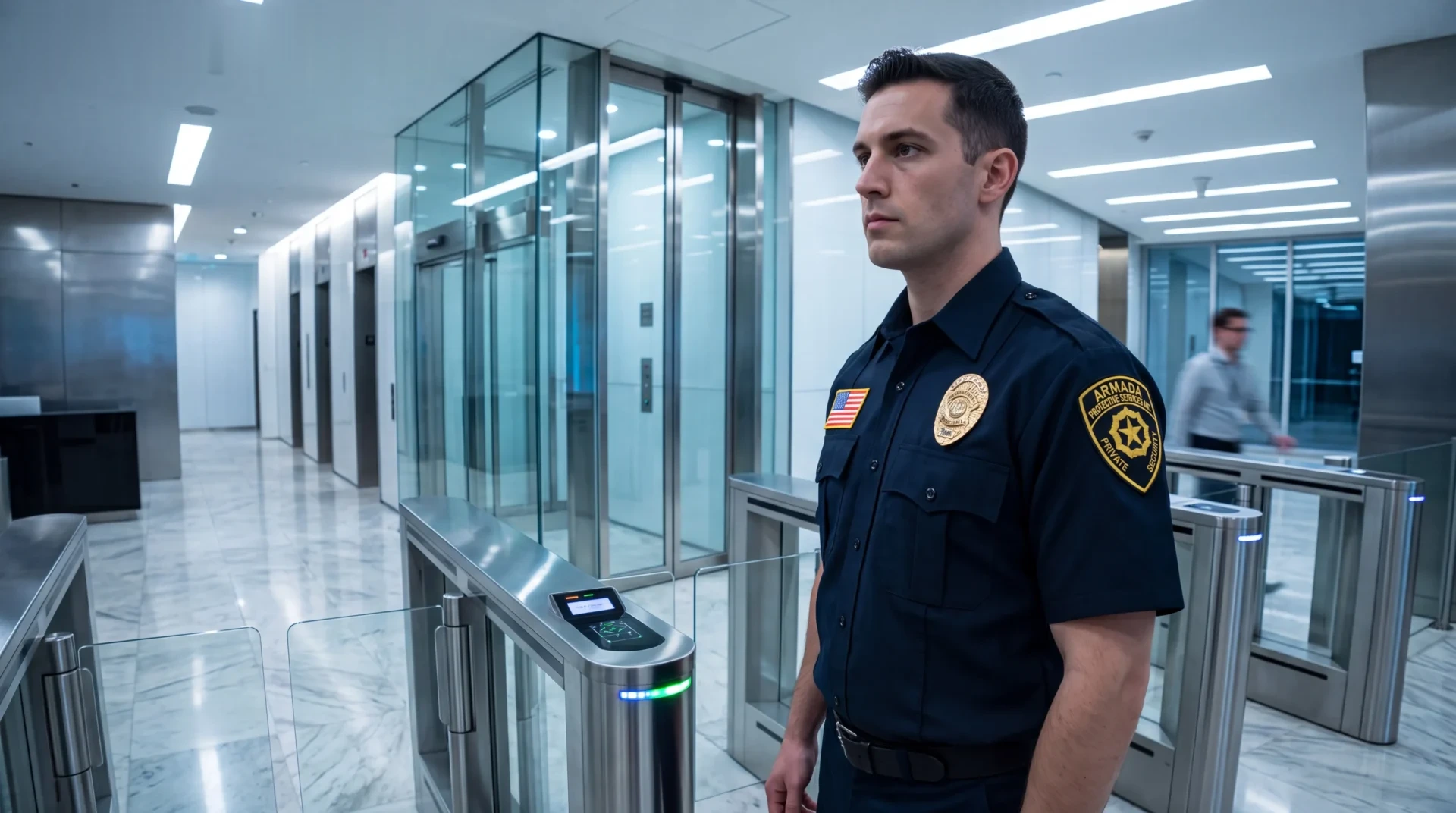
The gate line at a quarter to nine
Most of a working day's arrivals cross the lobby inside half an hour. That is the window in which following somebody through a gate stops looking rude and starts looking normal, and in which the officer who slows the line down is the one the tenants write to the manager about.
- A post position that watches the gate line and the elevator lobby at the same time
- A visitor pass that dies with the day and is handed back on the way out
- Broker tours, interview candidates and audit teams booked with the desk beforehand
- Somebody following a badge through the gate stopped there, not chased onto a floor
The sides of the building with no desk
A tower is watched from the one spot where somebody is sitting. The garage ramp, the service corridor, the dock and the stairwells have no such spot, and once the elevators stop running they are the way in that costs an intruder nothing to try. A property that is closed and posted as closed can file one notarized request for peace officer assistance that runs up to 12 months under California Penal Code section 6022, so the officer on site can have somebody moved on without waking the manager.
- Garage levels walked after the last tenant car has gone, not before it
- The dock counted as an entrance, because for half the week that is what it is
- Stairwell doors and the roof door tried, and the state of each one written down
- A round order that changes from night to night, so it cannot be learned from outside
How the post is run in an office building
An office post is judged on three mornings after: whether the visitor log can be read, whether the card list matches the people who actually work here, and whether the building's fire plan has a name written against every job in it.
Armada supplies and runs the post. The gates, the card readers and the cameras belong to the building, and we say so before anyone spends money on them. What we add is the person who works them and the paper that comes out at the end of the shift.
The desk through the morning peak
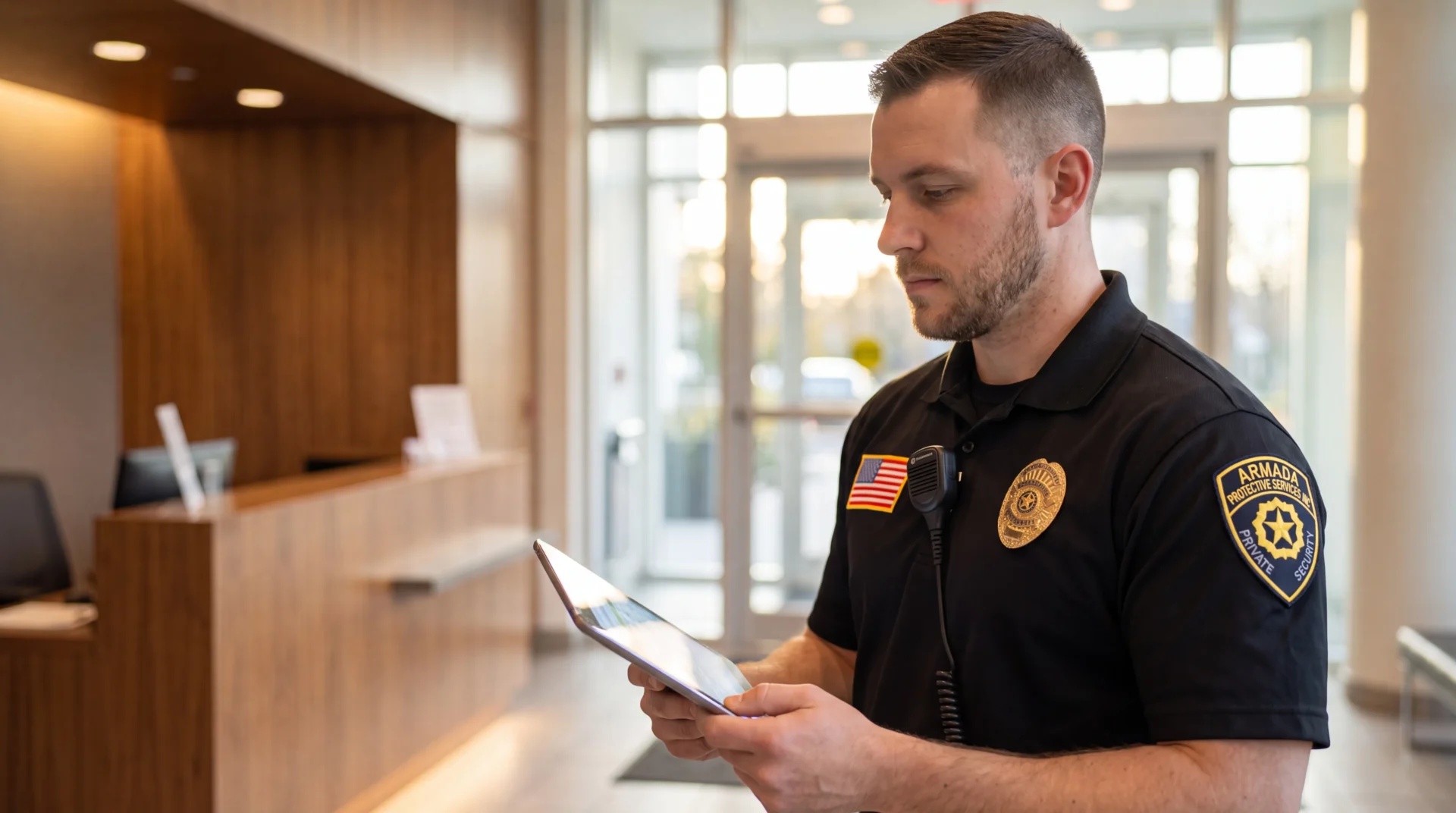
Headcount follows the traffic rather than the clock, because the hour that needs watching is not the hour that needs a body: where the gate line warrants it the lobby carries a second officer through the peak and one for the rest of the day, and the walkthrough settles which. Every arrival is matched to a named host at a named tenant, never to a company name on its own, and the host is reached before the visitor goes up.
The card list stays the manager's
We do not hold the access system and we do not decide who carries a card. The post produces the other half of it: a readout of which credentials were used, at which reader and at what time, so a card still opening doors for somebody who left in August turns up on paper instead of on the eleventh floor.
Evening contractors and the cleaning crew
After-hours work is cleared with the tenant and the building manager before the day shift ends, and the names reach the desk on a roster rather than at the door. A crew nobody expected waits in the lobby while the officer reaches the tenant contact, and the wait goes into the report whichever way it ends.
The closing round and what it leaves written
The last round of the day walks the garage levels, the stairwells, the dock and the roof door, and records the state each of them was left in. The shift is closed by its report rather than by the clock, so a post that comes off at eight is read at about nine. Anything that cannot wait until then is a call at the time.
Our Statistics. Your Guarantee.
A building manager can test all four of these before an officer ever stands in the lobby. Every officer is individually BSIS licensed and background checked, clients hold the direct numbers of the officers on their own site, and a building under contract is reached in 15 to 30 minutes. Armada has been the top-rated San Francisco security company since 2021 according to SFist3.

- 2x
At least twice as fast as police arrival
Under contract Armada is on site in 15 to 30 minutes. The median SFPD publishes for a low-priority call is longer, which is why SFPD itself points businesses to private security for anything short of a crime in progress.
- 80%
Fewer incidents at monitored properties
Weighted average across client sites, banks and hotels among them. It compares the incident records those clients kept before Armada covered the site with the records they kept after.
- 24/7
Your officer is the one you call
At two in the morning a building manager calls the officer standing in the lobby, not a call center in another state. Clients hold those numbers from the first shift, and the app carries the messages, the photos and the log.
- 100%
Licensed and insured
Every officer individually BSIS licensed and background-checked, under California Private Patrol Operator PPO 120526. Look it up yourself: License record PPO 1205264 in the California Department of Consumer Affairs register. Checked November 2026.
Related Security Services
The commercial properties Armada covers that stand closest to an office building.

Server rooms and restricted floors where every entry has to be proved rather than assumed.

Branch floors, vault doors and cash handovers that need a written procedure behind them.
Customer testimonials
What San Francisco property managers say about Armada
I Manager a portfolio of communities in San Francisco -working with Armada is great. They are flexible, honest and the Guards are always on point. I would recommend this firm to other HOA/Commercial managers.

Christopher Stanley
Owner and Chief Executive Officer, San Francisco
We hired Armada on short notice for a situation we were experiencing in one of our apartment complexes. They responded quickly, set up patrols and a guard service for us very quickly. Guards were professional, prompt and communicated activity at the property to us.

Lana August
Property Manager, San Francisco
We have used Armada for about 10 years. They are an amazing company providing professional personnel consistently. Thank you Armada!

Jesse Leite
Resident Manager, San Francisco
Every Armada employee with whom I've had the pleasure of interacting has been top notch - curteous, efficient, effective, knowledgeable, responsible.

Alex Goretsky
Business Owner, San Francisco
Quoted verbatim from published client reviews, including their original wording.

Walk the building with us
Send the address and a time. The free site assessment is a booked walkthrough: we meet you in the lobby, walk the gate line, the garage levels and the dock, write down what the post would have to do and price it before you commit. The minimum term is one month and month-to-month after that, and the written assessment is yours to keep whether or not you hire us.
FAQs
What building managers ask before they put a guard post in an office building.
Does our office building need a written fire evacuation plan and a yearly drill?
It does once the building holds 500 or more people, or more than 100 people above or below the lowest level of exit discharge. The threshold is 403.3 in the California Fire Code, section 4035, which puts an approved fire safety and evacuation plan on an office occupancy of that size, and Table 405.3 in the California Fire Code, section 4056 adds an evacuation drill every year with all occupants taking part. A smaller office building falls outside both unless the fire code official asks for a plan.
What has to be written down after an evacuation drill?
Clause 405.6 of the California Fire Code, section 4056 asks for a record of every required drill: who ran it, the date and time, how the occupants were notified, how many of them left, what was simulated, the problems met, the weather and how long the evacuation took. The record belongs to the building, not to the guard company. Our officers are usually the people who walk the floors on the day and hand the counts to whoever writes it up.
What counts as suspicious in an office building's after-hours access logs?
Control PE-6 of NIST Special Publication 800-537 names the patterns to look for: entries outside normal working hours, repeated entries to areas a person does not normally use, stays of unusual length, and entries that arrive out of sequence. The same control asks that the physical access logs be reviewed and that what turns up is passed to whoever handles incidents. That catalog is written for federal systems and says private organizations may use it voluntarily, so for an office tower it is a benchmark rather than a California rule.
What should the front desk write in the visitor log?
Control PE-8 of NIST Special Publication 800-537 lists the visitor's name and organization, a signature, the form of identification shown, the date, the time in and the time out, the purpose of the visit, and the name and organization of the person being visited. How long the log is kept is left for the building to decide. Our officers fill it in at the desk and it stays the building's record rather than ours.
Who is supposed to keep the building's access list, and how often should it be reviewed?
Control PE-2 of NIST Special Publication 800-537 puts it on the organization that owns the facility: develop, approve and maintain the list of people allowed in, issue the credentials, review the list on a set schedule, and take people off it as soon as the access is no longer needed. The catalog deliberately leaves how often to the organization, which in a multi-tenant tower means the building manager sets the interval and the tenants feed it. A guard company works the list and reports what was used against it; it does not own it.
What does the fire plan of a high-rise office tower have to spell out?
Clause 404.2.1 of the California Fire Code, section 4048 asks the plan to set out the egress routes and whether the building empties completely, by selected floors, or stays where it is under a defend-in-place response; how people who cannot use the exits unaided are brought out; how everyone is accounted for afterwards; and which named staff handle rescue or medical aid. A high-rise needs an approved plan whatever its headcount, which is clause 403.10.2 in the California Fire Code, section 4035. The guard post is one of the named jobs inside it, which is why the post orders and the plan are written against each other.
Ask us directly
If the answer you need is not here, send the question through the form and we will answer it with your building in mind.
Sources
Where the figures, rules and local facts on this page come from. Links reviewed 13 Nov 2026.
- Council on Criminal Justice 1 Crime in San Francisco published 21 October 2025, data January to June 2025 think-tank analysis of police-reported data, not a police statistic; non-residential burglary covers offices, stores and other non-dwelling buildings
- public.law 2 Penal Code 602 trespass; 602(o) covers refusing to leave property not open to the public and the standing written request for peace officer assistance
- SFist 3 Armada Protective Services: San Francisco's Top Security Company trade press, used only where no primary source carries the claim
- California Department of Consumer Affairs license search 4 License record PPO 120526 Armada Protective Services, private patrol operator
- UpCodes Codebook 5 Fire Code, section 403 2025, 6 Fire Code, section 405 2025, 8 Fire Code, section 404 2025
- National Institute of Standards and Technology 7 SP 800-53 Rev. 5 September 2020, updates to 10 Dec 2020 a federal control catalog; the publication states it may be used by nongovernmental organizations on a voluntary basis