Security for Tech Companies and Data Centers in San Francisco
A software floor and a machine room share one street address and ask for two different jobs: a room full of people who all belong there, and a room that runs all night with nobody standing in it.
This page is about the parts of that address a person has to hold. Who gets onto a floor with no interior walls, what a maintenance contractor is allowed to touch and when, what leaves the loading bay in a box, who is on site on the days the calendar says the office is empty, and what happens when an alarm sounds and the racks cannot simply be walked away from.
The visit costs nothing and the written assessment is yours even if you never hire us.

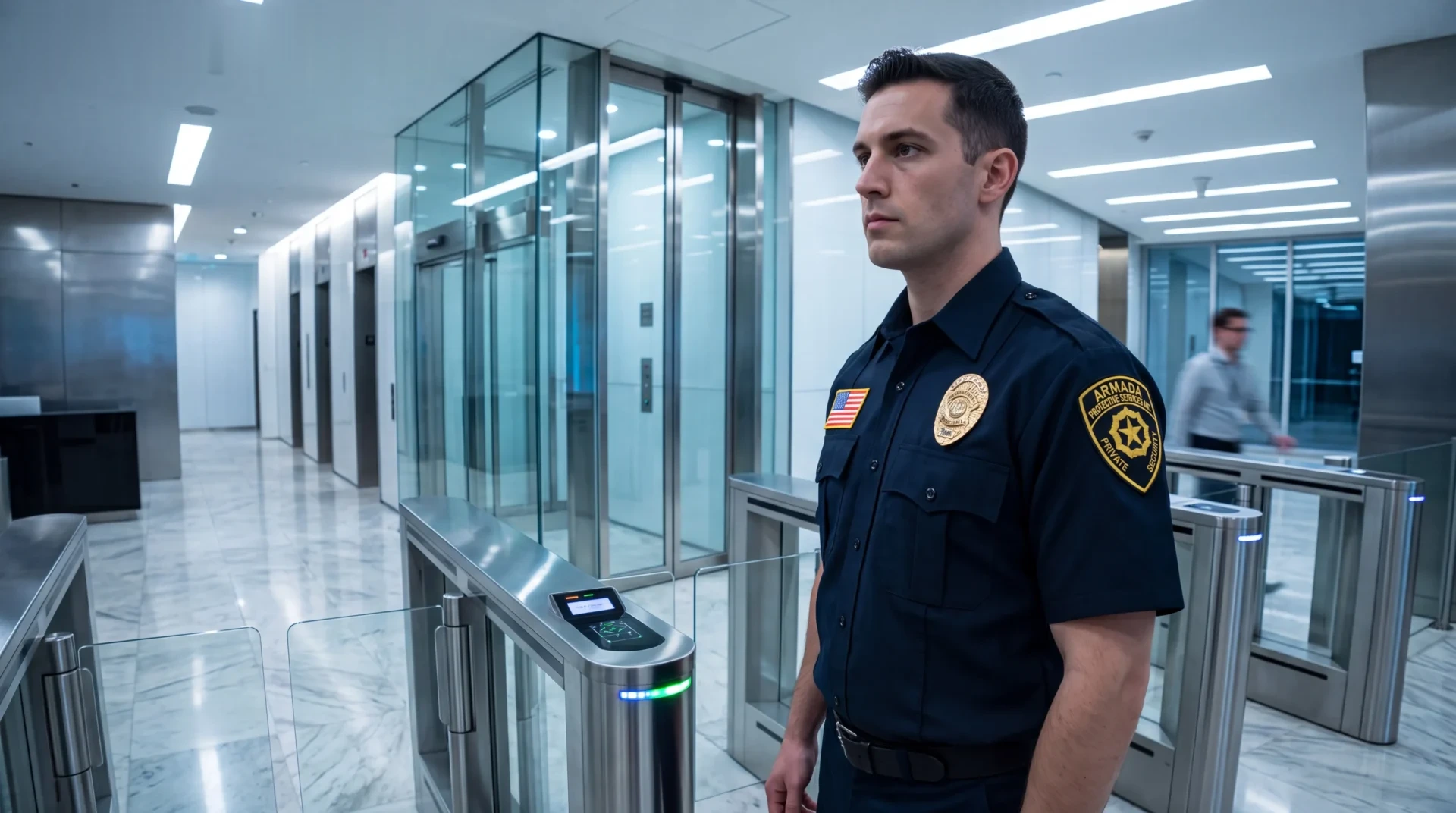
Why a tech floor is a harder door than it looks
The building is new, the badge readers work and everyone inside is pleasant about it. What makes the address awkward is that the floor has no interior walls, the equipment keeps running long after the desks empty, and most of what goes wrong is done by somebody who was let in on purpose.
Three commercial pages sit beside this one for buildings with the same street door and a different business inside: office buildings, corporate campuses and financial institutions. What follows belongs to the floor with the engineers on it and to the room with the racks.
The floor is one room, and the badge is the only wall
Open plan is the point of the place: no offices, no corridors, nothing between a desk by the window and a whiteboard covered in next quarter. It also means the only real decision anybody makes about a stranger is taken once, at the door. A guest who is signed in and then left to find the meeting room on their own has already walked past all of it.
- A guest met at the door by a named host instead of pointed at an elevator
- A pass issued for the day, carrying the host name, handed back on the way out
- Staff told plainly that holding the door open for a stranger is the thing we will ask about
The office goes home and the machine room does not
By eight the desks are empty while the racks still draw power, cooling still runs and the part of the address that would actually cost you money sits behind a door with nobody near it. Maintenance is booked for exactly those hours, so the quietest part of the night is also the part with the most unfamiliar people in it.
- A night route written around the machine room door, the risers and the rooftop equipment
- Vendor work on cooling, power and racks booked against a name and a window
- Each checkpoint scanned at the door it belongs to, so the round exists on paper
Hardware moves in and out, and so do the quiet days
Equipment leaves a tech address constantly and legitimately: a lease return, a failed array, a pallet of laptops going back to the vendor. A box walking out of the dock is only a theft when nothing says it was meant to go. The same gap opens on a holiday week or an all-remote Friday, when deliveries still arrive at an address everyone has been told is empty.
- Outgoing equipment matched to a named approver before the van doors close
- Deliveries on a closed day signed for at the dock, never left against a door
- Non-working days named in the post orders rather than settled on the Friday
The server rooms we can reach in time
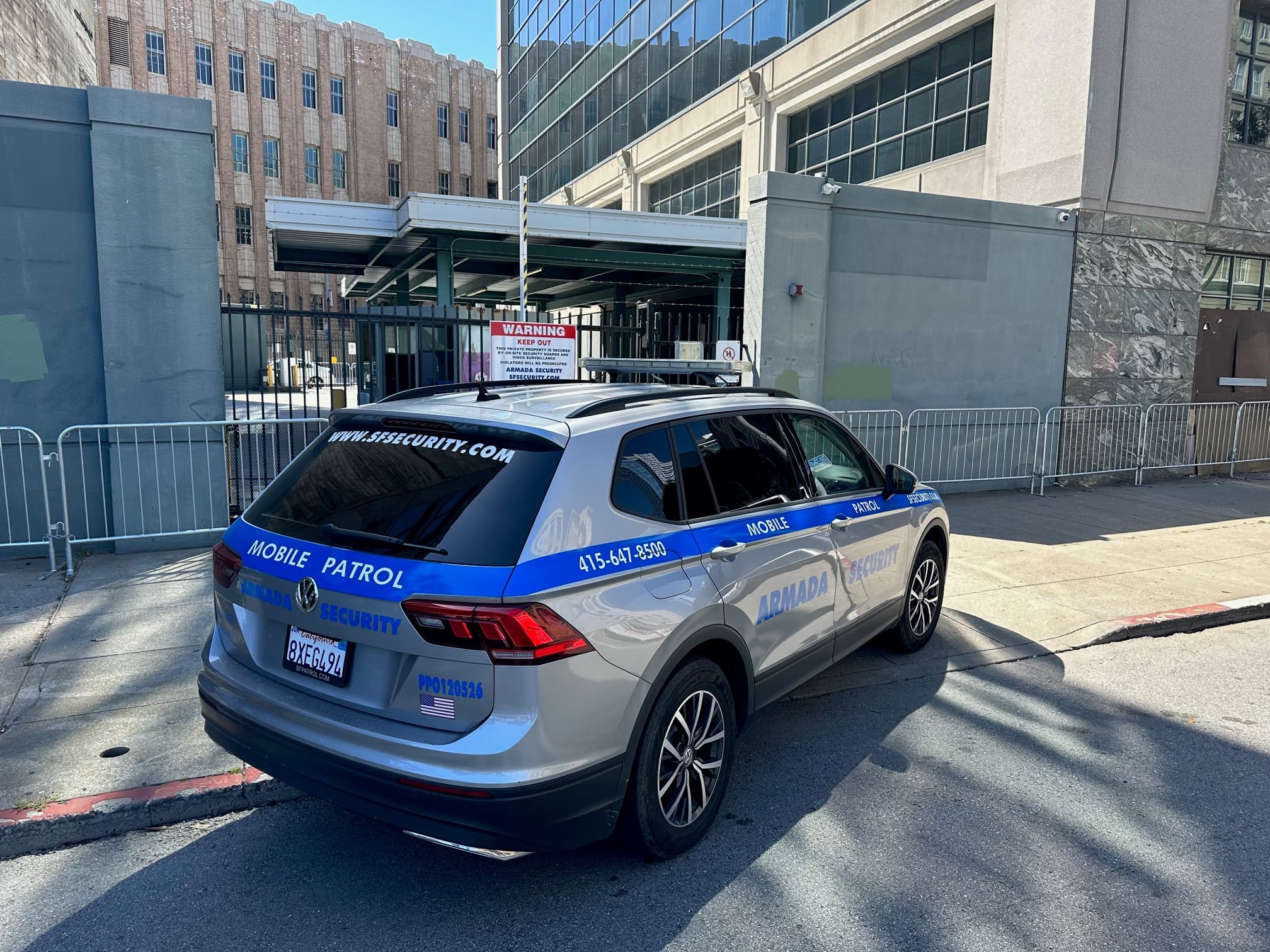
Everything runs out of one San Francisco office, so the officer standing on your floor and the supervisor who answers at two in the morning sit in the same room. A site under contract is reached in 15 to 30 minutes, measured in our own dispatch log from the moment the call lands to the moment the officer is logged on site.
We serve: San Francisco, San Mateo, Brisbane, San Jose (see all locations)
How the post is run on a tech floor
Four things decide whether this post earns what it costs: who gets onto the floor, who is allowed near the equipment, what goes out through the dock, and what the officer does in the first minute after an alarm sounds.
Officers are individually licensed by BSIS and background checked before a first shift, and Armada works under California PPO 120526. The controls below are not our invention: NIST Special Publication 800-53 Revision 5, Security and Privacy Controls1 keeps visitor access records, escorted maintenance and the delivery and removal of equipment as three separate physical controls, and post orders are written the same way. Armada guards the address and answers calls on it; it does not sell badge readers, cameras or turnstiles, and it will say so before you spend anything on them.
The desk on a floor with no doors
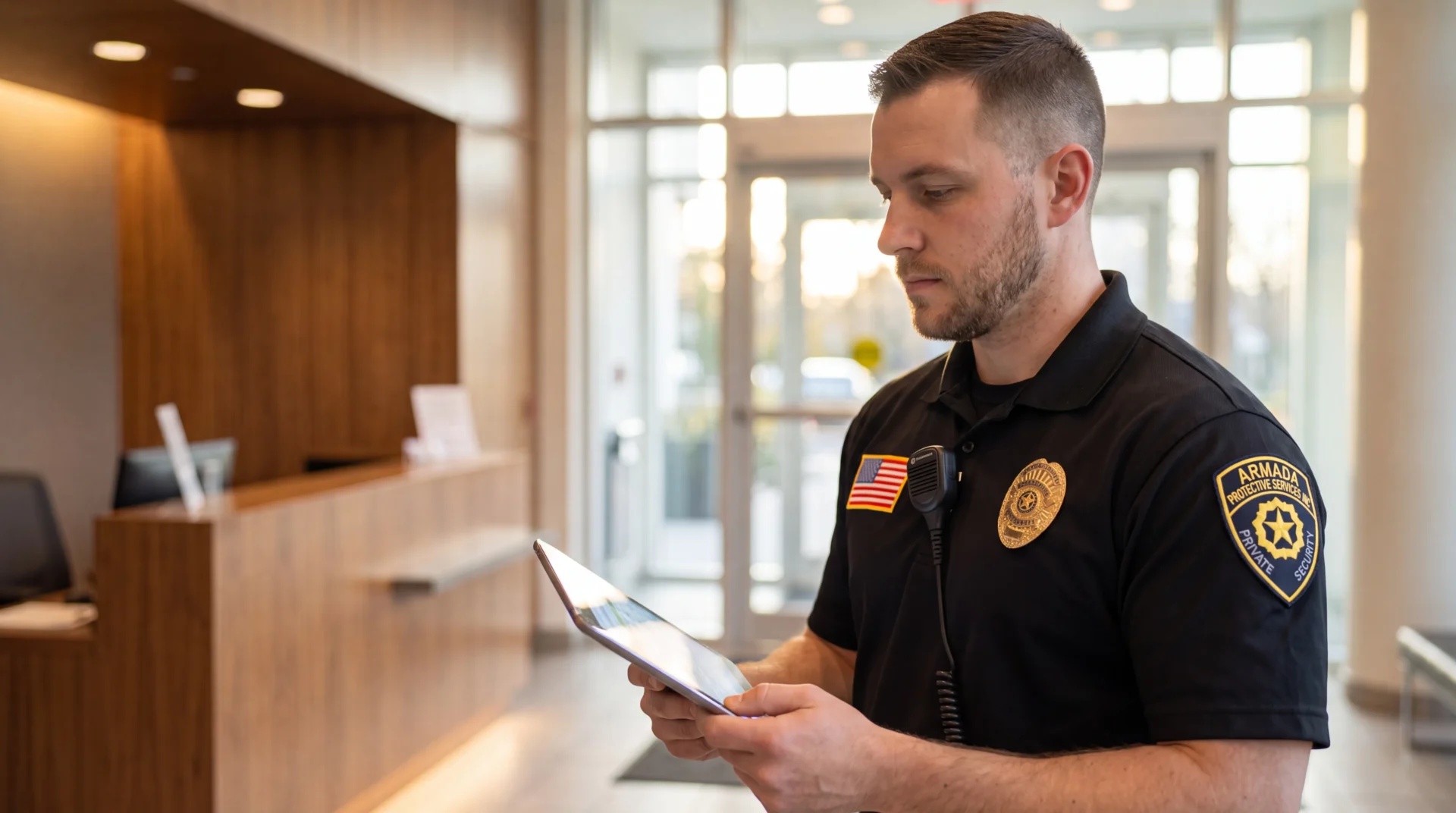
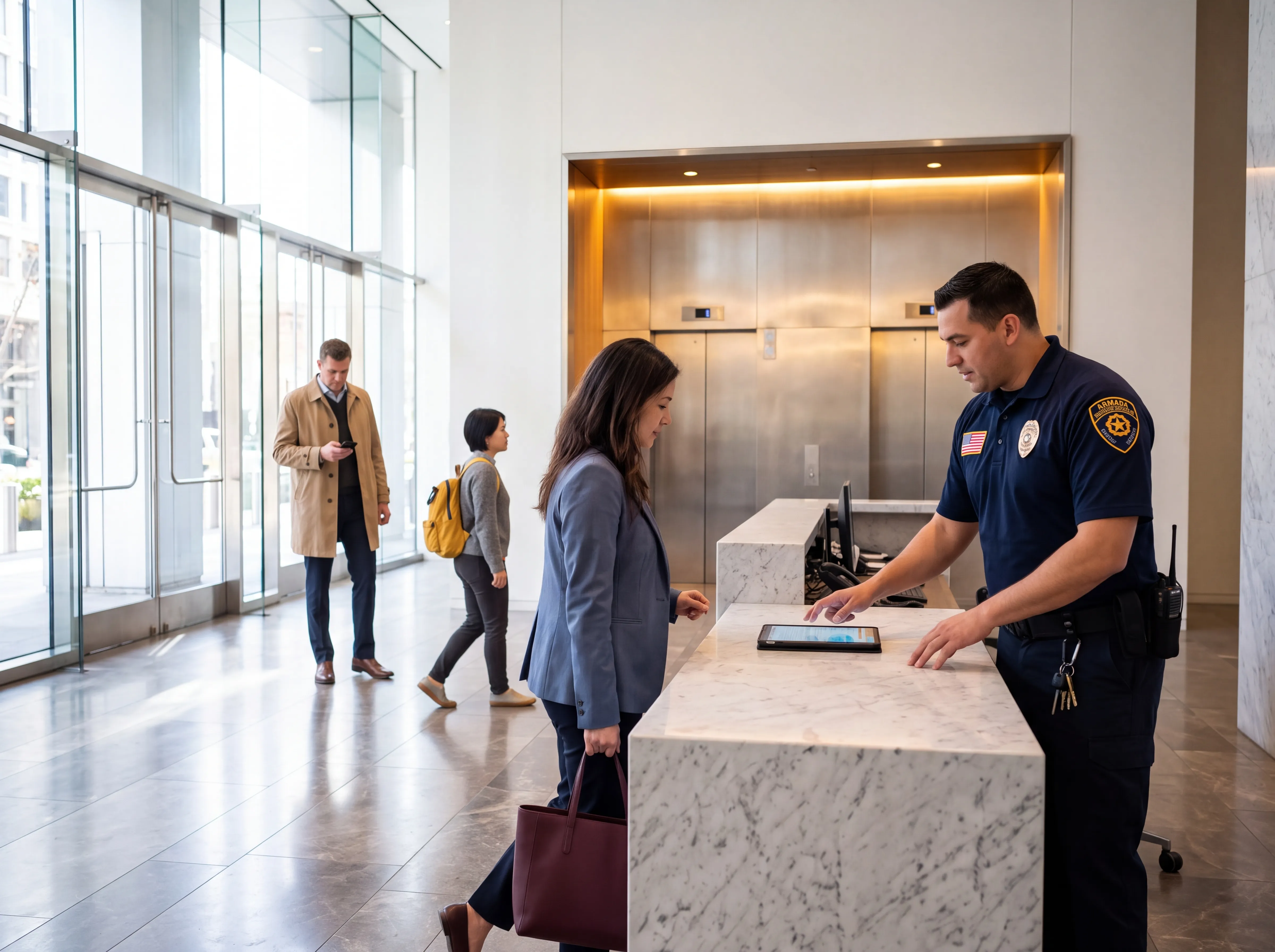
Reception here is one decision taken in front of whoever else is waiting: this arrival was expected, that one was not. The officer greets, names the host, reaches them, writes the arrival down and issues a pass that dies at the end of the day. The part worth examining before you buy is not the greeting. It is what is still readable six months later when somebody asks who was on the floor that afternoon.
- Name, host and time in for every arrival, and a time out when the pass comes back
- An arrival whose host cannot be reached waits in view of the desk, never waved through
- Somebody walking in behind a badge holder written up as an event, not excused as politeness
- The badge list stays yours to run; what we add is a record of who used it and when
A contractor is a visit, not a standing permission
The people most likely to be alone beside your equipment do not work for you: the cooling engineer, the cabling crew, the vendor swapping a failed drive, the cleaner carrying a pass cut two years ago. Each has a reason to be there and none of them should reach the machine room without a name, an agreed window and somebody who walked them in.
- Work windows agreed with your facilities contact before the van arrives, not at the gate
- An escort into the machine room and back out of it, logged at both ends
- A return outside the agreed window held at the desk and reported the same shift
- Passes surrendered when a job closes, so last year crews are not still on the list
What goes out of the dock in a box
Hardware leaving the building is normal, which is exactly what makes it useful cover. The cheapest control on this page is a line written at the dock before the doors close, and the person to write it is the one standing there anyway.
- Serial numbers read off the asset tags at the dock, not copied out of an email
- Incoming pallets received against a purchase order and never left on the bay floor
- Retired drives held in one locked place until the disposal vendor signs for them
- A loading bay door propped open treated as an open entrance, because it is one
The alarm that has to empty a floor quietly
An alarm on an open floor is a crowd problem before it is anything else: one stair core, a lot of people who have never walked it, and a machine room that cannot be abandoned in the middle of a transfer. California Fire Code 2025, section 4042 already requires the written plan. What an officer adds is somebody carrying out the parts of it that need a person.
- Stair doors held and the floor counted out, so the sweep is finished and not assumed
- A named way down for anyone who cannot use the stairs, agreed long before the day
- The machine room handed to the engineer on duty under a rule written in advance
- Drills walked with your own floor wardens, so the first rehearsal is not the real one
Our Statistics. Your Guarantee.
A facilities lead can check every claim on this page before signing anything, and none of it asks to be taken on trust. Every officer is individually BSIS licensed and background checked, clients hold the direct numbers of the officers on their own site, and a site under contract is reached in 15 to 30 minutes. Armada has been the top-rated San Francisco security company since 2021 according to SFist3.
- 2x
At least twice as fast as police arrival
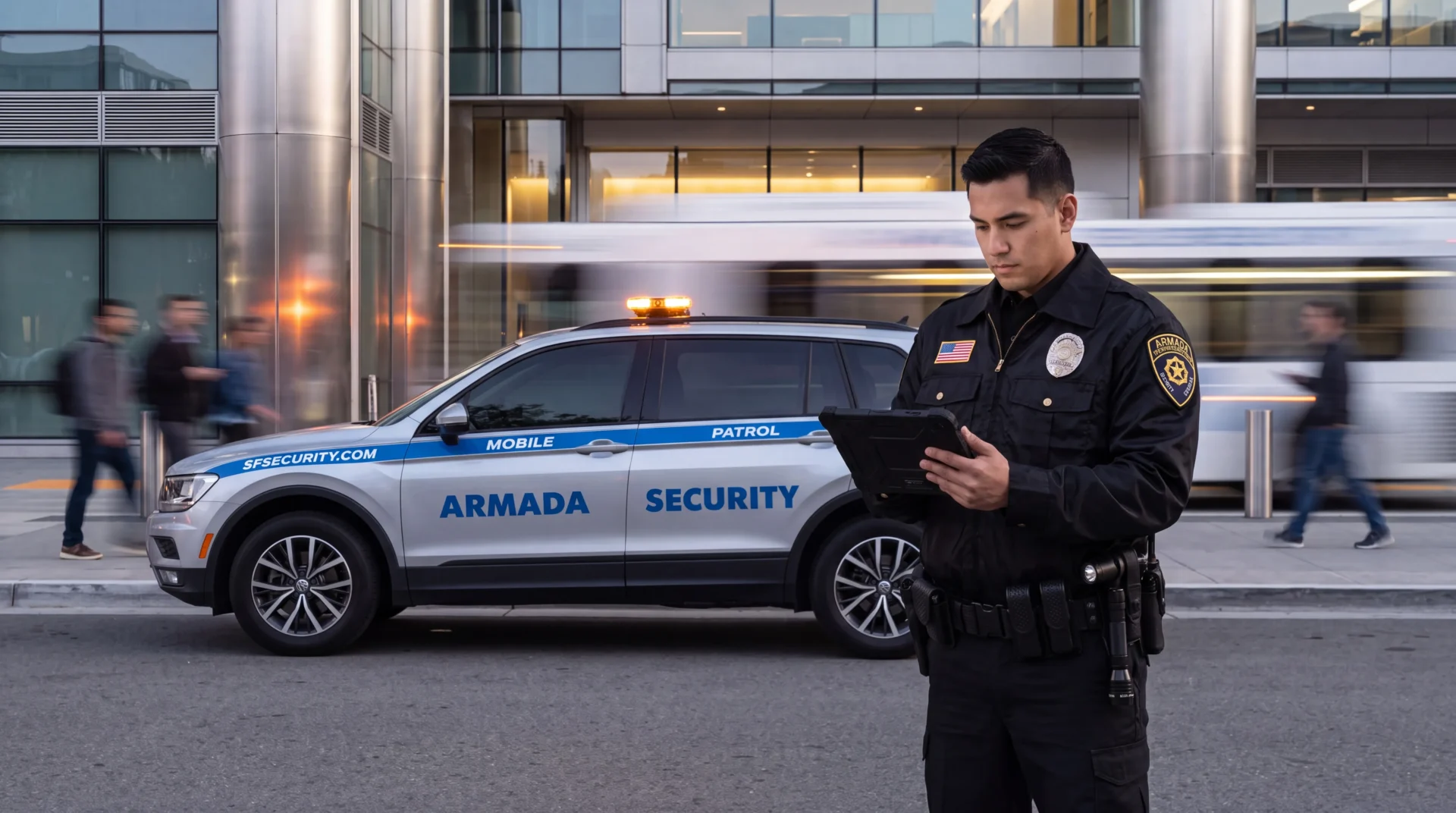
Under contract Armada is on site in 15 to 30 minutes. The median SFPD publishes for a low-priority call is longer, which is why SFPD itself points businesses to private security for anything short of a crime in progress.
- 80%
Fewer incidents at monitored properties
Weighted average across client sites. It compares the incident records those clients kept before Armada covered the site with the records they kept after.
- 24/7
Your officer is the one you call
At two in the morning a site manager calls the officer standing on the site, not a call center in another state. Clients hold those numbers from the first shift, and the app carries the messages, the photos and the log.
- 100%
Licensed and insured
Every officer individually BSIS licensed and background-checked, under California Private Patrol Operator PPO 120526. Look it up yourself: License record PPO 1205264 in the California Department of Consumer Affairs register. Checked November 2026.
Related Security Services
The three commercial pages nearest to this one, for the parts of a portfolio that are not the server room.
Constant foot traffic, several entrances and tenants who expect both safety and a professional front desk.
Security for corporate campuses in San Francisco and the Bay Area, across several buildings on one site.

Security that goes beyond standard protection measures for banks and financial institutions.
Customer testimonials
Professional and Reliable Security Services in the Bay Area
We hired Armada on short notice for a situation we were experiencing in one of our apartment complexes. They responded quickly, set up patrols and a guard service for us very quickly. Guards were professional, prompt and communicated activity at the property to us.

Lana August
Property Manager, San Francisco
We have used Armada for about 10 years. They are an amazing company providing professional personnel consistently. Thank you Armada!

Jesse Leite
Resident Manager, San Francisco
Every Armada employee with whom I've had the pleasure of interacting has been top notch - curteous, efficient, effective, knowledgeable, responsible.

Alex Goretsky
Business Owner, San Francisco
I Manager a portfolio of communities in San Francisco -working with Armada is great. They are flexible, honest and the Guards are always on point. I would recommend this firm to other HOA/Commercial managers.

Christopher Stanley
Owner and Chief Executive Officer, San Francisco
Quoted verbatim from published client reviews, including their original wording.

Walk the floor and the machine room with us
Give us half an hour on site, from the street door to the rack aisle. You get told what a stranger could do with the address this afternoon: the badge door that opens on a push, the dock that stands open all afternoon, the machine room key that half the engineering team is carrying. The site visit is free, the written assessment is yours whether or not you hire us, and the contract that follows opens at one month and runs month-to-month after that.
FAQs
What facilities leads, IT directors and office managers ask before a tech or data center contract opens.
Our badge system already logs every door. What does an officer add?
A log tells you which credential opened a door. It cannot tell you who was holding it, who walked in behind, or whether the engineer who badged into the machine room at eleven at night was expected. An officer is the part of the control that makes a judgment in front of the person and writes it down: the arrival that did not fit, the door propped open, the second visit nobody booked. The system and the officer answer different questions, and you need both answers to reconstruct an afternoon.
We lease two floors inside another company's building. Can you still cover us?
Yes, and the first thing to settle is where the landlord stops and you start. The building usually owns the street door, the lobby desk and the loading bay, while your contract begins at the elevator doors onto your own floors. We write that line into the post orders with the building manager in the room, so an arrival is never passed back and forth between two desks, and we agree in advance who the building calls at night and who calls you. Where the landlord already runs a visitor system we write into it rather than start a second one beside it.
Can you cover the nights and the holidays only, not the whole week?
Yes, and on a lot of tech addresses that is the sensible shape. The daytime floor already has reception, so the hours worth buying are the ones where the building is running without an audience: evenings while vendor work is booked, weekends, the holiday weeks and the company offsite. The term opens at one month and runs month-to-month after that, which is short enough to try one pattern and change it.
Nobody is on site at three in the morning and the panel goes off. Who answers?
The officer who covers your address, and he attends. Alarm response is a service of its own here, so an address with no night post still gets a person at the door rather than a phone call: the officer walks the perimeter, the machine room door and the dock, and you are sent photographs of what was found instead of a line saying the alarm cleared. What we do not do is watch the signal itself. Your monitoring company keeps that contract; we are the people it sends.
Do you install the badge readers, the cameras and the sensors?
No. Armada sells guarding, patrol and response and nothing else. We will advise on what an address should install, write the requirement and check that the installed work meets it, but we do not supply the equipment. A provider who sells you the hardware and then guards the result has an obvious reason to recommend more hardware.
How is a data center post different from an office building post?
By what the night is for. In an office building the closed hours are mostly empty and the job is rounds and door checks. A data center is busiest with strangers exactly when the office is dark, because that is when vendors are allowed to touch anything, so the night post is an escort and an access record rather than a patrol. On a corporate campus the same two jobs sit on one site, in different buildings, on different hours.
Ask us directly
If the answer you need is not here, put the question in the form and we will answer it ourselves.
Sources
Where the figures, rules and local facts on this page come from. Links reviewed 12 Nov 2026.
- National Institute of Standards and Technology 1 SP 800-53 Rev. 5 September 2020, updates to 10 Dec 2020 a federal control catalog; the publication states it may be used by nongovernmental organizations on a voluntary basis
- UpCodes Codebook 2 Fire Code, section 404 2025
- SFist 3 Armada Protective Services: San Francisco's Top Security Company trade press, used only where no primary source carries the claim
- California Department of Consumer Affairs license search 4 License record PPO 120526 Armada Protective Services, private patrol operator