
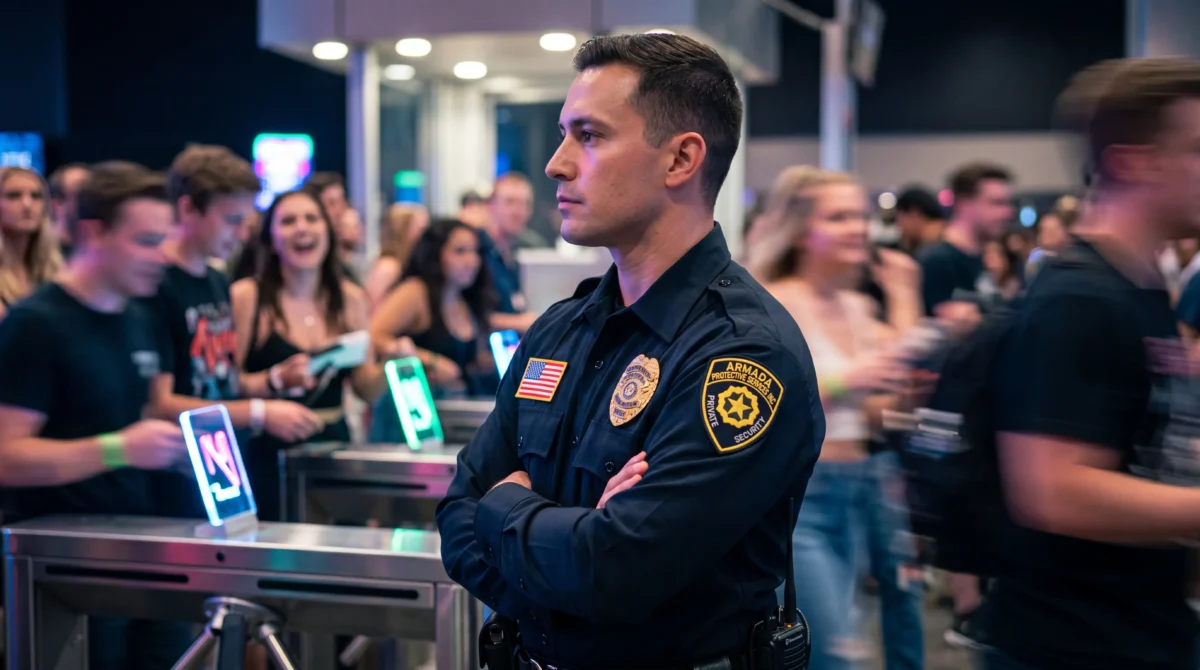
Effective concert security planning requires a structured approach to manage crowds, protect assets, and meet local rules. For Bay Area venues, this work calls for close coordination between venue management and state-licensed professionals. As a result, operations directors can protect their sites while keeping the space safe for attendees.
Strong concert security planning starts with matching coverage to the real risks at your site, not a generic package.
The Core Elements of Concert Security Planning
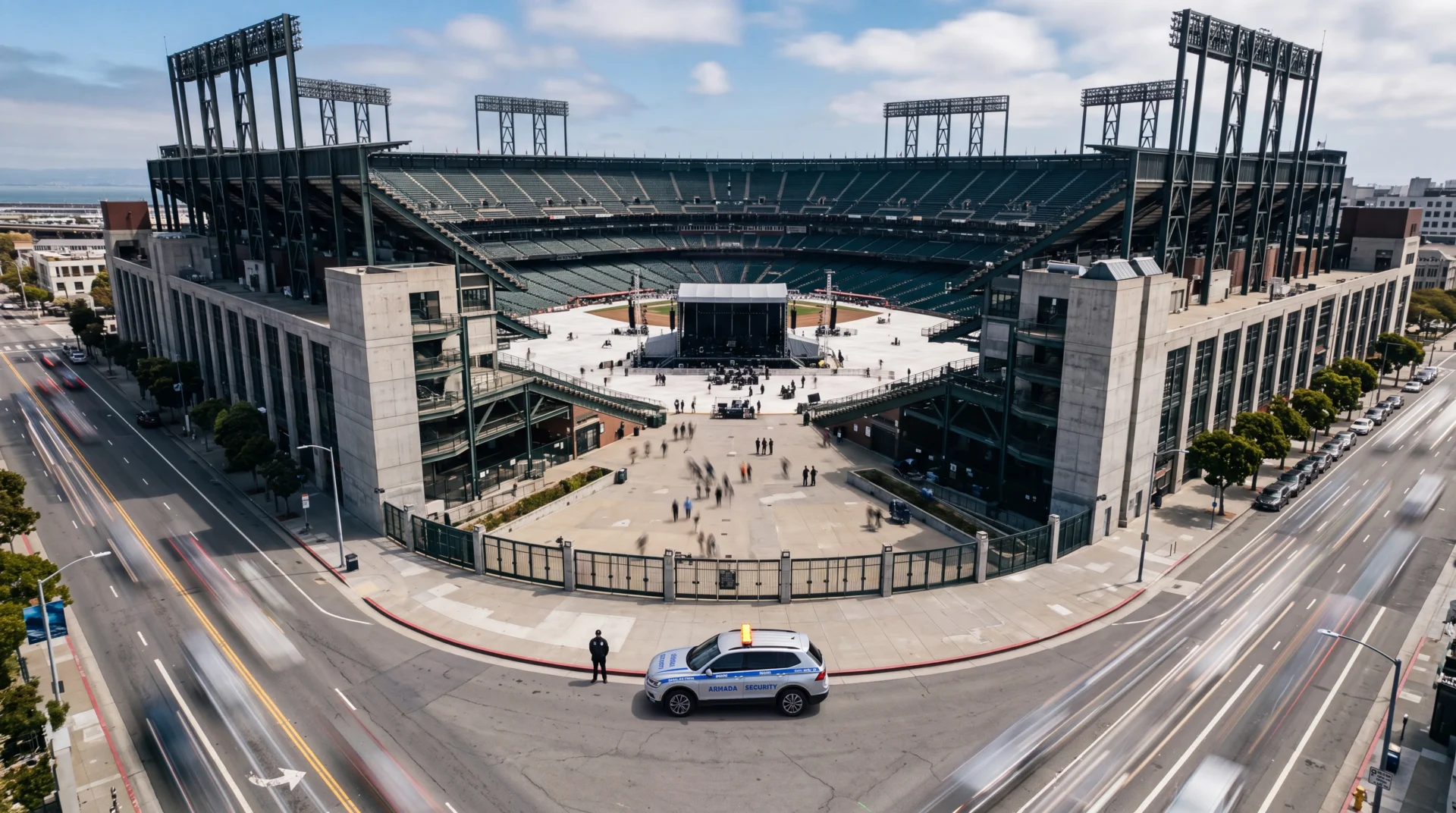
First, strong event management starts with clear communication and early planning. Because every venue has unique weak points, we must review the site layout weeks before any performance. For example, large outdoor arenas need different perimeter controls than historic indoor theaters. Therefore, your team must map all entry points, emergency exits, and high-traffic areas early in the process.
In addition, controlling physical access is a key part of protecting your commercial property. Consequently, we recommend setting up separate zones for attendees, staff, and performers. Because unauthorized access can disrupt operations, clear lines help keep the event on track. So, your plan should show how staff will verify credentials at every checkpoint.
Finally, remember that compliance remains a top priority for facility directors. As a result, you must align your security plan with state rules and local codes. For instance, the State of California requires proper licensing for all private security personnel. By working with a fully licensed provider, you help ensure your operations meet these legal standards.
Crowd Management and Perimeter Control Strategies
Managing large groups of people is a complex task that calls for steady attention. However, proper planning makes crowd flow easier and helps prevent bottlenecks at the gates. First, you should design a clear queue system to guide guests safely into the venue. For example, physical barriers help keep lines orderly during peak arrival times.
Next, consider how your staff will handle bag checks and credential screening. Because slow lines can frustrate guests, you need enough trained personnel to keep the process moving. In addition, clear signs help guests understand venue rules before they reach the front of the line. So, place signs about prohibited items well before the screening area.
Meanwhile, perimeter security helps prevent uninvited people from entering the site. Because open perimeters create risk, we must set strong physical barriers around the property. Consequentely, regular patrols along these boundaries are needed to spot any breach. As a result, you protect your venue and keep the inside area safe.
- Establish clear queue lines with physical barriers.
- Set up visible signage detailing prohibited items.
- Assign trained staff to specific perimeter zones.
- Monitor exit routes to keep them clear of obstructions.
Compliance, Licensing, and Local Regulations
Operating a commercial venue in the Bay Area involves close regulatory oversight. Therefore, compliance must be at the center of your event prep. For example, the California Department of Consumer Affairs regulates private security through the Bureau of Security and Investigative Services. Thus, venue managers must make sure their security partners hold a valid BSIS Private Patrol Operator License. Our BSIS license is PPO 120526, reflecting our commitment to state standards.
Because local city codes vary, your plan must fit the specific city where your venue operates. For instance, we serve 12 cities across San Francisco, the Peninsula, and San Jose. These cities include:
- San Francisco
- San Jose
- San Mateo
- Daly City
- South San Francisco
- Hillsborough
- Sausalito
- Burlingame
- Colma
- San Bruno
- Brisbane
- Millbrae
Each of these areas has different police and fire department rules. Consequently, coordinate with local authorities well before the event date. Because local police and fire officials know the risks in the area, their input is very useful. As a result, you can align your internal team with local emergency services. This step supports a faster, more coordinated response if an incident occurs on your property.
Integrating Professional Personnel with Venue Operations
Commercial security is not a separate service. Instead, it must fit smoothly into your existing facility operations. For example, your security personnel must work closely with guest services, ticketing staff, and facility maintenance. Because these teams must act as one unit, clear communication channels are essential. So, we recommend joint briefing sessions before the gates open.
In addition, professional personnel must know the layout of your property. For instance, they need the exact locations of utility shut-offs, medical stations, and fire extinguishers. Consequently, we conduct detailed site walk-throughs during the planning phase. As a result, our team can guide attendees quickly and safely in an emergency.
To learn more about tailored services for large-scale venues, view our concert and festival security services. By partnering with experienced professionals, you can focus on managing the event while we manage the perimeter. This division of labor keeps your operations efficient and secure.
Conducting a Thorough Risk Assessment
Before the first guest arrives, your team must identify likely hazards. Because every venue faces different risks, a formal risk assessment is a vital tool. For example, weather conditions, crowd size, and the venue layout all shape your risk profile. Therefore, we analyze these factors to build a custom security plan.
First, review the structural safety of your property. For instance, make sure all temporary structures, like stages and barricades, meet local safety codes. Next, plan for medical emergencies by setting up dedicated first-aid areas. Because medical issues can happen at any time, clear access paths for emergency vehicles are critical. As a result, local paramedics can reach patients without delay.
In addition, we recommend reviewing emergency guidelines from the Federal Emergency Management Agency to align with national standards. Because emergency planning is an ongoing process, you should update your plans after every event. So, gather feedback from your team to improve your future concert security planning.
Choosing the right concert security planning in San Francisco comes down to a licensed provider, clear post orders, and reporting your team can actually audit.
Frequently Asked Questions
What should a Bay Area venue or property manager check first before hiring concert security for a show or festival?
Start with the firm’s California license and the scope of work. Armada Security is licensed by the State of California as a BSIS Private Patrol Operator, PPO 120526, and we work B2B only for commercial sites, venues, and event spaces. Then confirm the plan covers your site layout, crowd flow, entry points, staff posts, and escalation steps in plain writing.
How do we judge whether a concert security plan is strong enough for liability and compliance in San Francisco?
A sound plan names who does what, when, and how problems are reported. Look for clear post orders, check-in steps, incident logging, and a chain of command that fits your venue, board, or operations team. If a provider cannot explain how they help your team document issues and respond to them, the plan is too thin.
What security issues most often go wrong at concerts and festivals, and how should our plan handle them?
The common failures are weak access control, gaps at high-traffic points, slow response to disorder, and poor handoff between venue staff and security. Your plan should map entrances, queue lines, stage or load-in areas, and the points where your team needs faster support. It should also define when local site staff, management, and outside responders are notified.
How fast can security coverage be set across San Francisco and nearby cities if our event or site needs support?
Armada Security serves 12 cities across San Francisco, the Peninsula, and San Jose, including San Francisco, San Mateo, Daly City, South San Francisco, Burlingame, and San Jose. For scheduling, ask how the firm staffs recurring needs across your exact location, event times, and access points. A credible provider will confirm coverage based on site needs, not promise a blanket response without seeing the work.
What should boards and facility directors ask if they manage a multi-family or mixed-use event space that hosts concerts or festivals?
Ask whether the provider understands that residential work means multi-family and apartment communities, condos, and HOAs managed through boards or property teams, not single-family homes. Then confirm they can support a commercial event plan without drifting into consumer or home-security sales. The right fit will speak to your rules, tenant impact, site control, and ongoing coordination with management.
Related reading
- Office Building Security San Francisco
- How to Ensure Top-Notch Event Security Services
- Retail Security San Francisco: Protect Your Store with Armada Security
