
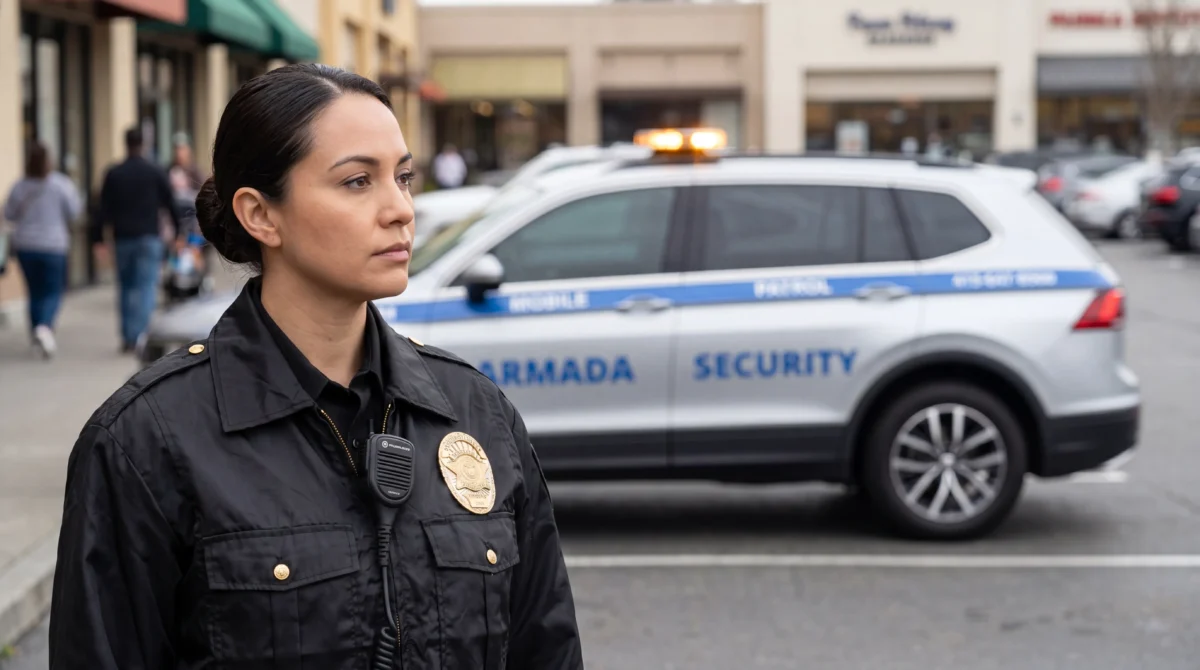
Parking security in San Francisco is a patrol problem: a garage or lot is too large to watch from one post, so the only thing that works is an officer who keeps moving (through the levels, the stairwells, the perimeter) on a schedule criminals cannot predict. That is the program Armada Security runs for commercial garages, surface lots and multi-family parking structures across the city, with BSIS-licensed officers (Private Patrol Operator license PPO 120526) under long-term B2B contracts.
What parking facilities are up against
Vehicle crime is the dominant property-crime category in San Francisco, and parking structures concentrate it:
- Break-ins targeting visible valuables in parked cars.
- Catalytic converter theft, still elevated across the Bay Area.
- Vandalism to gates, payment systems and vehicles.
- Trespassing and encampment in stairwells and unused corners.
- Patron safety on the walk to the car after dark (the issue tenants actually complain about).
An unwatched lot near a busy corridor is a routine target; a lot with a moving uniformed patrol mostly is not. Our own operational data across guarded sites shows about an 80% deterrence rate: the incident that never starts is the cheapest one. When incidents do occur, our officers typically reach them about twice as fast as police (SFPD deprioritizes vehicle break-ins in practice), then coordinate the handoff.
The program
- Randomized active patrols: officers walk the structure on varied routes; no desk-sitting. Every round is GPS-tracked and presence is verified via TrackTik, so the patrol you pay for is a patrol you can see in the log.
- Access and gate control: entry management to keep non-patrons out.
- After-hours coverage: lock checks, dark-corner sweeps, perimeter verification overnight, when most vehicle crime happens.
- Safety escorts: on-request walks for tenants and guests to their vehicles.
- Incident response and reporting: immediate action on alarms and hazards, with a daily written log delivered to your team every morning.
Garage vs surface lot
The two need different designs. A multi-level garage is a vertical patrol problem: stairwells, elevator lobbies and the top deck need scheduled sweeps, and blind corners decide the route. A surface lot is a perimeter problem: sightlines, lighting and the fence line matter more than rounds. We set the program after a walk-through of your specific structure, not from a standard package.
Mixed-use structures (retail on the ground floor, tenant parking above) need a third design: patrol windows aligned to the retail closing hour, when customer flow stops masking who enters the structure. A schedule built only around “overnight” misses that transition window; post orders for mixed-use sites should name the closing hour explicitly and put an officer on the entry level for it.
Event garages near venues and stadiums need a fourth design entirely: a short, high-density staffing window around ingress and egress rather than a flat overnight schedule, since the risk in an event garage concentrates in the thirty minutes before and after the crowd moves. We staff those separately from the standing contract, scaled to the event calendar rather than a fixed weekly post count.
What property managers get
- A dedicated site supervisor accountable for your property.
- Daily digital patrol logs, plus monthly activity summaries.
- 24/7 dispatch for urgent needs.
- No-missed-shift guarantee with rapid officer replacement.
- Flexible staffing for event nights and peak seasons.
Coverage typically starts within 48 hours of a signed agreement. We serve parking facilities across San Francisco (SoMa, the Mission, the Financial District, the Marina, Bayview, Dogpatch) and 11 more cities across the Peninsula and San Jose. Verify our license (PPO 120526), or any provider’s, in the California BSIS lookup.
Frequently Asked Questions
What does parking security cost in San Francisco?
Cost follows coverage hours and structure size: an overnight-only patrol for a small surface lot is a different program than 24/7 coverage of a multi-level garage with gate control. The honest way to price it is a walk-through of your structure (levels, entrances, lighting, incident history) and a program matched to your actual risk windows rather than a flat package.
Do patrols actually reduce vehicle break-ins?
Visible, unpredictable patrols change target selection: break-in crews scout for unwatched lots, and a moving uniformed officer takes the site off the list. Across our guarded sites, our internal data shows roughly 80% of incident types simply stop occurring after coverage starts. What patrols cannot do is protect valuables left in plain sight: signage plus patrol works better than either alone.
Can officers escort tenants or customers to their cars?
Yes, safety escorts on request are part of the standard program, and for multi-family and office garages they are usually the most visible benefit tenants notice. Escorts are logged like any other patrol activity, so property managers can see usage in the daily report.
Who handles an incident, your officers or the police?
Our officer on site responds first, documents the incident and coordinates the police handoff when one is needed. In practice SFPD deprioritizes vehicle break-ins, so the contractor’s response time is the one that determines the outcome; ours typically beats police to the scene by half or more, per our own operational data.
