
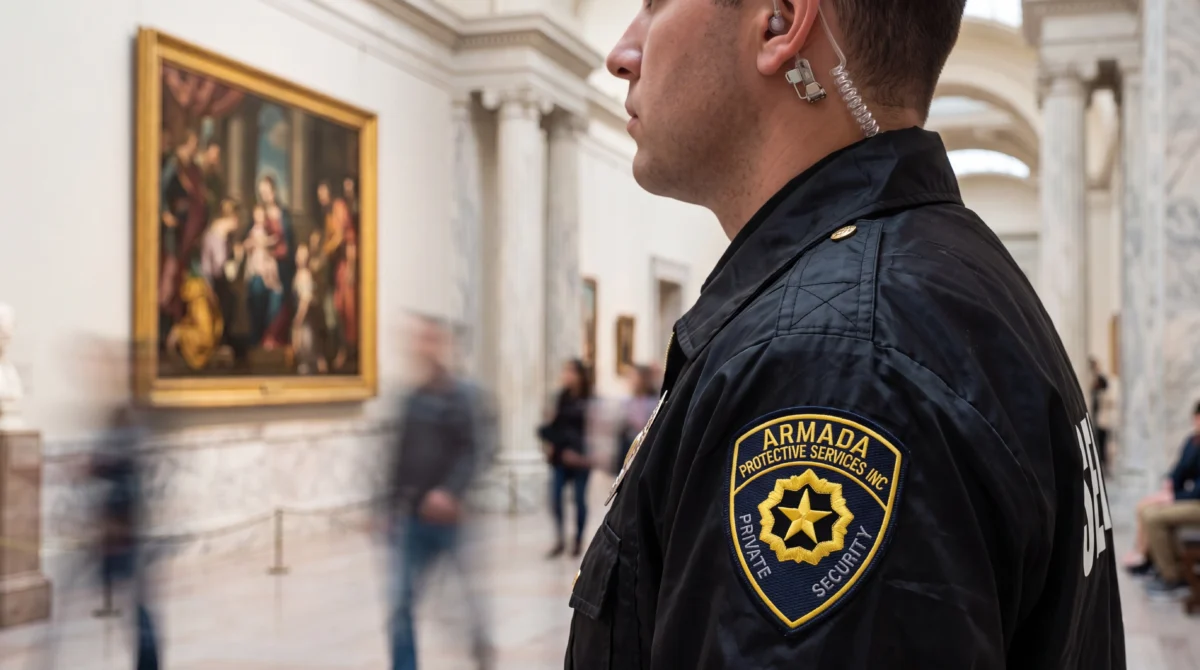
Museum security guards protect cultural assets, manage visitor flow, and secure public facilities under strict compliance. These trained professionals blend asset protection with service. They help institutions protect history while keeping the public welcome.
Strong museum security guards start with matching coverage to the real risks at your site, not a generic package.
The Specialized Role of Museum Security Guards
Cultural sites must balance open access with strong protection. For this reason, professional museum security guards do more than watch doors. They monitor galleries, assist lost visitors, and stop people from touching fragile exhibits.
Security should never feel harsh or closed off. So, guards train in soft skills, service, and de-escalation. As a result, they can calm tense moments before damage reaches the facility or its name.
They also work with curators to learn the risks in each gallery. Some exhibits may be sensitive to flash photos or sudden movement. So, a trained guard knows what to watch for in every room.
Core Protocols for Protecting Cultural Assets
Securing a cultural venue takes a clear risk plan. First, guards set access control at every entry and exit point. This helps keep unapproved people out of storage rooms and archives.
Next, regular patrols help spot water leaks, heat shifts, and other hazards. Because fragile pieces can worsen fast, early notice matters to conservation work. According to the American Alliance of Museums, proper risk planning and facility care are key to avoiding long-term harm to collections.
A typical daily schedule for a guard includes several clear tasks:
- Conducting pre-opening sweeps to check alarms, barriers, and fire exits.
- Monitoring live surveillance feeds from high-value galleries and public zones.
- Verifying credentials for visiting researchers, contractors, and staff members.
- Assisting with safe emergency evacuation drills during peak hours.
These duties create a layered defense that keeps both people and art safe.
Licensing and Compliance Standards in California
Commercial sites must put compliance first when they choose a security partner. In California, all professional security providers must hold active credentials. Armada Security is fully licensed by the State of California under BSIS Private Patrol Operator License PPO 120526.
Working with a licensed provider also helps confirm that guards meet state training standards. This compliance matters for the insurance rules that often apply to high-value exhibitions. As a result, facility directors can have greater confidence that liability is handled with care.
We provide these long-term commercial services across 12 key cities in the Bay Area:
- San Francisco and South San Francisco
- San Jose and San Mateo
- Daly City and Hillsborough
- Sausalito and Burlingame
- Colma and San Bruno
- Brisbane and Millbrae
Because we focus only on commercial B2B contracts, our team understands the compliance needs of modern operations directors.
Crowd Management and Public Safety Strategies
High-profile exhibitions can draw large crowds into historic or delicate spaces. During these busy times, strong crowd control takes close planning. For instance, guards manage queue lines at popular galleries to prevent overcrowding.
In addition, they work with local emergency services to plan evacuation routes. If a medical issue or fire occurs, guards must lead anxious visitors to safety with calm and clear direction. Because disorder can lead to accidental damage, a steady response is essential.
Experienced guards also train for many scenarios. These range from minor trip-and-fall events to major natural disasters. In this way, their presence helps keep your facility safe for learning and public use.
Securing a Dedicated Long-Term Partnership
Short-term fixes rarely give museums the deep site knowledge they need. Instead, long-term partnerships allow guards to learn your building layout and emergency plans well. Over time, that knowledge supports faster response and stronger protection.
Our focus is strictly on recurring B2B relationships. We do not provide short-term, one-night security or consumer home security. We serve property managers, facility directors, and institutional leaders who want stable, compliant protection.
A dedicated security partner will also complete a full site review to find hidden weak points. By studying your traffic patterns and entry points, we can build a plan that supports your goals. As a result, you get a reliable defense plan built for the long run.
Frequently Asked Questions
How do we know a museum security guard team is licensed and lawful in San Francisco and the Bay Area?
Start with the State of California PPO license, not a sales pitch. Armada Security is licensed by BSIS as Private Patrol Operator PPO 120526, and that is the level of proof a museum, gallery, or board should ask for before any site work begins. For Bay Area sites, also confirm the team can cover your city and that the service plan fits a B2B site, not a home.
What should we ask about guards before we let them near art, archives, or public exhibits?
Ask how the team handles access control, visitor flow, and what to do if a piece is at risk. You want guards who work from clear post orders, know when to call site leadership, and can stay calm in front of guests. For museums and galleries, the best fit is usually a guard team used to commercial and institutional sites, not general public-facing work only.
How do museum security guards reduce liability if there is damage, a dispute, or an incident on site?
Your risk drops when duties are clear, reports are written the same way every time, and the site has a defined chain of call. Ask how incidents are logged, who gets notified, and how the service supports your own records for insurance, owners, or the board. A good vendor should help you close gaps in access, response, and handoff without overstepping your own policy.
What is the right way to compare response time for museum security in San Francisco versus the Peninsula or San Jose?
Do not compare by a promise alone. Compare by city coverage, local staffing, and whether the provider serves your actual locations across San Francisco, the Peninsula, and San Jose, including San Mateo, Daly City, South San Francisco, Hillsborough, Sausalito, Burlingame, Colma, San Bruno, Brisbane, and Millbrae. The faster team is the one with a real local footprint and a plan for your hours, your gates, and your busiest public times.
What usually goes wrong when a gallery or museum hires the wrong guard service?
The most common failures are weak post orders, slow reporting, poor guest judgment, and guards who are not used to controlled, public-facing sites. That can lead to access errors, missed signs of trouble, and stress for staff who then have to fix the gap. Choose a B2B provider that serves organizations like property managers, venue teams, corporate sites, and institutional spaces, because that is the level of work this setting needs.
Museum & gallery security | FAQs
What are the duties of museum security guards?
What security guard duties are specific to cultural institutions?
How do I hire a security guard for a museum?
