
Security Guard Services in San Francisco — What You Need to Know for Reliable Protection
Professional security guard services in San Francisco provide trained personnel who protect people, property, and assets through a visible presence, access control, and structured incident management. This guide walks through how guards operate in the city’s urban landscape, the service types available, which industries benefit most, and how to evaluate costs and vendors so you get dependable protection. Many property managers and business owners face theft, vandalism, trespass, and the coordination challenges that come with dense, mixed-use neighborhoods; this article delivers practical, actionable guidance to solve those problems. You’ll learn why trained guards matter, the differences between armed and unarmed deployments, how mobile patrols and alarm response workflows operate, which services align with commercial, residential, industrial, and public properties, and what drives pricing across the Bay Area. We also include comparative tools and checklists to help you brief vendors and compare proposals efficiently. Read on for a local-first view of security guard services in San Francisco and the steps to secure effective protection.
Why Professional Security Guard Services Matter in San Francisco
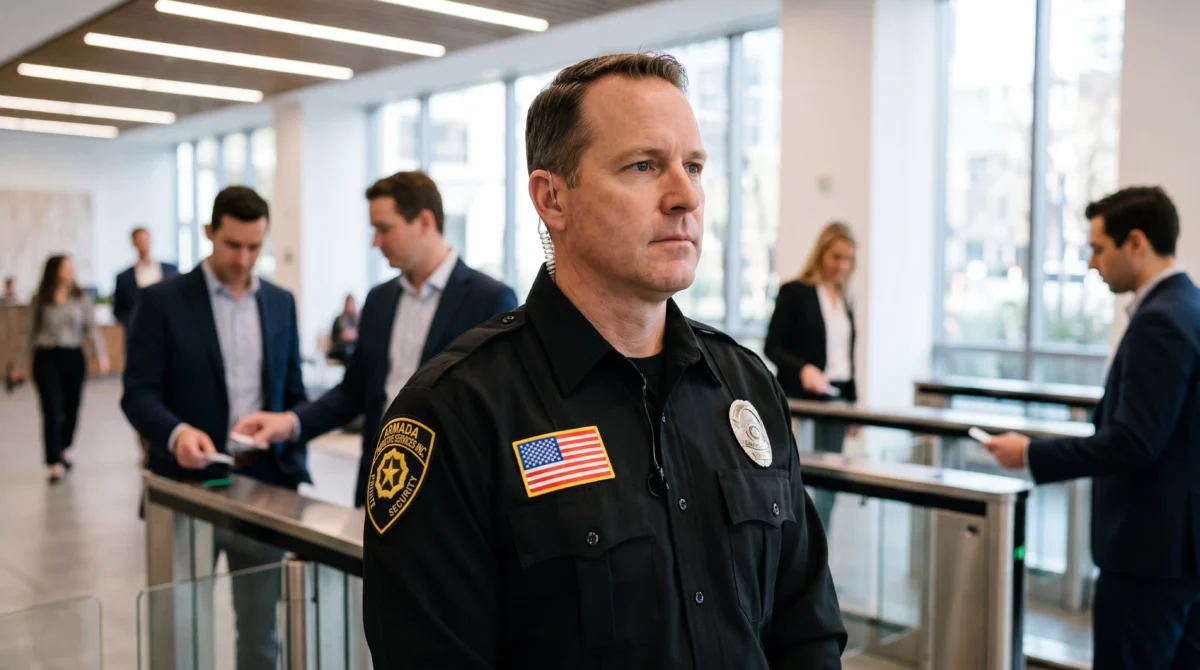
Professional security guards reduce risk by combining deterrence, fast incident response, and coordinated access control tailored to San Francisco’s neighborhood patterns and property types. A trained, visible guard discourages opportunistic crime while also acting as a calm, prepared responder who de‑escalates incidents and documents events for follow-up. The measurable business benefits include lower shrinkage, stronger tenant confidence, and clearer incident records for insurance and enforcement. Knowing these practical advantages helps property managers choose the right service model and make informed decisions about patrol cadence, post orders, and technology that extend security guard services san francisco effectiveness. The section below breaks down the local drivers that make professional guarding an operational necessity across many parts of the city.
Local Security Challenges San Francisco Businesses and Residents Face
San Francisco’s security landscape is shaped by dense commercial corridors, busy transit hubs, and a mix of residential and commercial uses that create varied risk profiles by neighborhood. Common issues include shoplifting and package theft, vandalism, unauthorized encampments near transit or parks, and occasional large-event crowd control. Those realities call for flexible security plans that balance visible deterrence with quick escalation paths. Patrol routes and guard training should reflect local patterns — for example, late-night deliveries in innovation districts or concentrated retail areas that attract theft. Frequent coordination with security services and the ability to adapt patrols to changing conditions are essential to effective incident management.
Effectiveness of Security Guards and Surveillance in Public Place Crime Prevention
This review examines a range of public-area surveillance methods used to prevent crime, including CCTV, improved lighting, security guards, place managers, and defensible space. Across twelve studies that met inclusion criteria, defensible space measures such as street closures showed consistent crime-reduction effects in inner-city neighborhoods. Security guards showed promising results—particularly when deployed in car parks and targeted at vehicle crime—while the evidence for place managers remained inconclusive. The paper discusses policy and research implications.
Reconceptualizing public area surveillance and crime prevention: Security guards, place managers and defensible space, BC Welsh, 2010
How Security Guards Improve Safety and Deter Crime in San Francisco
Guards improve safety through a continuous, trained presence, strict access control, and clear de‑escalation and reporting protocols that reduce repeat incidents and speed investigations. Effective on-the-ground tactics include randomized patrol routes, staffed uniformed posts at higher-risk locations, credential checks at entry points, and proactive engagement with employees and residents to discourage risky behavior. Typical, measurable results include fewer petty crimes, a reduction in false alarms after policy adjustments, and improved tenant perception of safety. Strong programs also integrate with local law enforcement and emergency services so escalation follows established channels — a theme we return to when comparing service types and deployment scenarios.
- Deterrence and Visibility: A uniformed presence discourages opportunistic crime and nuisance activity.
- Rapid, Trained Response: Guards provide immediate on-site assessment and coordinate first-responder actions before police arrive.
- Accountability and Documentation: Detailed incident reports and logs create evidence trails for enforcement and insurance claims.
Core Types of Security Guard Services Available in San Francisco
San Francisco providers offer armed and unarmed posts, mobile patrols, event security, fire watch, and alarm response — each suited to different risk profiles and regulatory requirements. Armed guards are appropriate where high-value assets or elevated threat levels exist; unarmed guards cover customer-facing roles and access control efficiently. Mobile patrols give scalable coverage across multiple sites or for vacant properties, often using scheduled GPS-verified routes. Alarm response services link monitoring centers with on-site verification. Event security and fire watch are specialized deployments requiring focused training and close coordination with venue staff and emergency responders. The list below summarizes the main security guard services san francisco types and their typical use.
- Armed Security: Licensed, weapon-carrying officers for high-value asset protection or elevated-threat locations.
- Unarmed Security: Cost-effective, visible guards for reception, access control, and routine patrols.
- Mobile Patrols: Vehicle-based teams that perform scheduled checks, alarm verification, and rapid site assessments.
- Event Security and Fire Watch: Short-term, trained staff for crowd management, hotwork monitoring, or post-incident fire safety.
This overview sets up the comparison table below so you can match a service to your operational needs.
As a local example, Armada Protective Services packages armed and unarmed guards, specialized personnel, fire watch, mobile patrols, alarm response, and event security with GPS-verified reporting and rapid-response workflows to improve accountability and escalation. That combination of trained staff and technology reflects how Bay Area operators typically deliver reliable, auditable security coverage.
| Service Type | Primary Use-Case | Licensing / Training Needed | Typical Response/Availability |
|---|---|---|---|
| Armed Security | Protecting high-value assets or sites with elevated threat levels | BSIS firearm permits, advanced tactical and legal training | Continuous on-site posts or rapid deployment options |
| Unarmed Security | Retail floor coverage, lobby desks, visitor management | State guard registration and site-specific training | Regular shifts with daytime and night coverage |
| Mobile Patrols | Multiple-site checks, vacant properties, alarm verification | Driver and patrol procedures training plus GPS logging | Scheduled patrols with on-call verification |
| Event Security | Crowd control, entry screening, emergency procedures | Event-specific certification and crowd-management training | Temporary staffing aligned with event schedules |
| Fire Watch | Hotwork protection and temporary fire-safety coverage after system outages | Fire-safety training and coordination with local fire authorities | Continuous, short-term coverage as required |
| Alarm Response | On-site verification after alarm activations or breaches | Alarm-handling protocols and monitoring coordination | Rapid dispatch following alarm notifications |
Use this comparison to determine which service type best fits your site and to shape vendor scopes and pricing conversations. Next, we map these services to industry-specific needs in San Francisco.
Which Industries and Properties Gain the Most from Security Guard Services?
Different property types need different mixes of guard services. Corporate offices often prioritize lobby control and credential checks, industrial sites focus on perimeter protection and site safety, and residential communities value gate management and neighborhood engagement. Public venues require scalable crowd management and layered emergency response. Matching the right service types to each industry ensures a cost-effective program with measurable results.
Recommended primary approaches by industry:
- Commercial / Corporate: Lobby security, access control, and scheduled patrols.
- Residential / HOA: Gate and visitor management, community-oriented patrols, and night coverage.
- Industrial / Construction: Mobile patrols, perimeter checks, and fire watch during hotwork.
- Public Facilities / Venues: Event staffing, crowd control, and coordinated alarm response.
The table below links common property types to their typical security needs and the services that best address them.
| Industry / Property Type | Common Security Needs | Recommended Service Types |
|---|---|---|
| Commercial / Corporate | Access control, visitor screening, loss prevention | Unarmed guards, lobby/security desk, mobile patrols |
| Residential / HOA | Gate control, resident relations, package protection | Unarmed patrols, concierge/security blends, scheduled mobile checks |
| Industrial / Construction | Theft prevention, site safety, after-hours protection | Mobile patrols, fire watch, specially trained guards |
| Public Facilities / Venues | Crowd management, emergency planning, perimeter control | Event security, alarm response, coordinated officer presence |
This mapping helps prioritize features when you draft scopes of work or request proposals. The next section explains why choosing a local, experienced firm matters and what capabilities to evaluate.
Why Choose Armada Protective Services for San Francisco Security
Armada Protective Services is a Bay Area security firm with more than 32 years of local experience. We combine neighborhood knowledge, a digital operations platform for GPS-verified reporting, fast response workflows, BSIS-certified training, and established coordination with local emergency services. Those attributes create transparent accountability: GPS logs and client dashboards show patrol activity and incidents, while trained officers follow clear post orders and escalation steps. Our goal is to help businesses and property managers select security programs that are effective, measurable, and tailored to San Francisco’s unique operating environment.
We emphasize measurable outcomes through technology and local know-how, which speeds incident verification and documents patrol coverage for contract compliance. When evaluating providers, look for firms that can demonstrate GPS-verified patrol reporting, BSIS-certified guard rosters, and documented escalation procedures tied to local responder relationships. The sections that follow describe how local experience and a digital operations backbone translate into client benefits and transparency.
How Armada’s Local Knowledge and 32+ Years of Experience Help Clients
Longstanding local experience delivers practical advantages: familiarity with neighborhood patterns, established channels with emergency services, and tested staffing plans for recurring events and peak periods. Our patrol routes and post orders reflect real incidents and responder workflows, which shortens escalation time and improves outcomes when something happens. Neighborhood insights also allow proactive prevention — for example, adjusting patrol timing during seasonal trends or large events — and feed into the reporting systems that provide clients with clear documentation and faster follow-up.
How Our Digital Operations System Supports Real-Time Reporting
Armada’s digital operations platform records GPS-verified patrol logs, timestamped incident reports, and client-accessible dashboards that increase accountability and speed decisions. The system captures patrol checkpoints, documents significant interactions, and uploads photos and notes in near real time so clients and site teams can review events without delay. That transparency reduces disputes over coverage and improves post-incident analysis for prevention planning. Combining BSIS-certified personnel with a solid digital backbone supports both operational reliability and regulatory or contractual compliance.
Optimizing Security Guard Deployment in Large Public Spaces with Evolutionary Framework
This study proposes an evolutionary framework to automatically generate optimal guard deployment strategies for large public spaces. It introduces a new evaluation metric and an evolutionary solver based on differential evolution to optimize deployments. Tested on synthetic scenarios and a real-world case, the framework outperformed several common strategies, particularly in reducing guard response times.
An evolutionary framework for automatic security guards deployment in large public spaces, J Zhong, 2023
How Much Do Security Guard Services Cost in San Francisco?
Costs in San Francisco vary by guard type, shift structure, site complexity, required training, and local labor and permit considerations — all of which affect hourly rates and total contract value. Armed officers command higher rates because of licensing and insurance needs; mobile patrols can spread costs across multiple sites but include travel and vehicle expenses; event and fire-watch staffing often carry premium short-term rates. Knowing the main cost drivers helps you scope accurate proposals and compare vendor quotes. Below is a breakdown of primary rate factors followed by tips for getting precise bids.
- Guard Type: Armed or specialized guards cost more due to licensing, training, and higher liability coverage.
- Hours and Shifts: Night and weekend shifts often include premium differentials and overtime costs.
- Site Complexity: Multi-entrance sites, hazardous areas, or multiple posts increase supervision and staffing needs.
- Equipment and Technology: GPS-verified patrol systems, body cameras, or integrated monitoring add upfront and ongoing costs but raise accountability.
These drivers feed into the cost-factor table below to explain why each element affects pricing and what you should expect when evaluating proposals.
| Rate Factor | Why It Matters | Expected Impact on Rate |
|---|---|---|
| Guard Type (armed vs unarmed) | Licensing, training, and liability vary significantly between armed and unarmed personnel | Armed guards raise hourly rates substantially |
| Hours / Shift Structure | Premiums for nights, weekends, and overtime change labor costs | Extended hours or split shifts increase total contract expense |
| Location / Permit Requirements | Local permits and prevailing wages influence base pricing | Central urban locations typically carry higher rates |
| Specialized Training / Equipment | Industry certifications and gear increase staffing complexity | Certifications and equipment raise per-guard costs moderately |
This table clarifies the levers that affect pricing and helps you read vendor quotes more accurately. The next section explains how to request reliable estimates.
What Drives Security Guard Service Rates in San Francisco?
Labor market conditions, municipal permit rules, and a site’s risk profile collectively shape pricing; San Francisco’s wage and permitting rules often put baseline rates above the national average. Site complexity — mixed-use properties, multiple entrances, or required liaison with city services — typically increases supervision needs or specialized training. Shift mix and overtime exposure can materially change a proposal’s total cost, as can required technology such as GPS logging or camera integration. Those factors make detailed site information essential when soliciting bids.
How to Get Accurate Security Quotes
To get precise quotes, provide vendors with a clear package: a site map, number and hours of required posts, a history of incidents and known risks, desired technology integrations (for example, GPS-verified reporting), and any regulatory or HOA constraints. Ask for sample post orders and incident-report templates to compare operational rigor, and request a cost breakdown that separates hourly rates, supervision fees, vehicle charges, and onboarding or uniform costs. Evaluate proposals on total cost plus documented services and reporting standards rather than on headline hourly rates alone to avoid hidden fees. When possible, schedule a site walk with prospective providers to validate assumptions and refine scope — that step yields more comparable and accurate bids.
If you want a streamlined estimate, Armada Protective Services offers consultations and custom quotes based on a site assessment and documented scope; sharing a site map, expected hours, and known risks will produce the most accurate estimate from our team. This converts cost education into an actionable procurement process.
Frequently Asked Questions
What qualifications should I look for in a security guard service provider?
Look for firms that employ BSIS-registered guards and can show clear training programs in conflict resolution, emergency response, and customer service. Ask for industry experience relevant to your site and for sample post orders and reporting templates. Verified certifications and a track record in your property type are strong indicators of operational maturity.
How can technology improve the effectiveness of security guard services?
Technology enhances accountability and response times. GPS tracking verifies patrols, real-time incident reporting speeds decision making, and integration with surveillance and alarm systems enables quicker on-site verification. These tools reduce disputes over coverage and help providers show measurable performance.
What are the benefits of hiring unarmed security guards?
Unarmed guards offer a visible, non‑threatening presence well suited to lobbies, retail, and residential settings. They tend to be more cost-effective than armed officers and focus on access control, customer service, and de‑escalation techniques — a good fit for environments where a less aggressive approach is preferred.
How do security guard services adapt to different property types?
Providers tailor services to each property by assessing risks and operational needs. Commercial sites typically need access control and loss-prevention patrols; residential communities prioritize gate management and resident relations; industrial sites require perimeter checks and safety watches. A site-specific assessment drives the right mix of staffing, training, and technology.
What should I expect during a security consultation?
A consultation should include a site walk, review of maps and known risks, and a discussion of existing measures. Expect recommendations on service types (fixed posts, mobile patrols, event staffing), a draft scope, and an initial cost estimate. Good providers will also outline reporting options and escalation procedures.
How can I ensure my security service complies with local regulations?
Verify that the provider’s guards are BSIS-registered and that the company understands local permit and ordinance requirements — especially for armed posts. Regular audits, clear contracts outlining roles and rules of engagement, and open communication help maintain compliance as regulations change.
Are Armed Security Guards Legal and Common in San Francisco?
Armed security is legal in California when officers hold the required BSIS firearm permits and have completed mandated firearm and tactical training. Armed deployments are typical where threats to life or high-value assets make the added protection necessary. Many managers choose unarmed guards for everyday access control and public-facing roles, reserving armed officers for vaults, cash handling, or sites with documented elevated risk. Weigh the deterrent benefits against escalation risk, liability, and insurance costs, and always require proof of current certifications and clear rules of engagement in any security services contract.
Why Mobile Patrols Matter in San Francisco Security
Mobile patrols extend coverage across multiple properties cost-effectively and are especially useful for vacant sites, construction zones, and HOAs that need nightly perimeter checks without continuous on-site staffing. GPS-verified patrols provide checkpoints and timestamps so managers can confirm coverage and review incident timelines. Mobile teams also perform alarm verification and initial assessments before fixed staff or local responders arrive, which reduces false-alarm costs and speeds verification. For many organizations, a hybrid approach — periodic mobile patrols plus targeted fixed posts — balances cost and security services while preserving clear reporting.
When you’re ready to explore a tailored security plan, Armada Protective Services can conduct a site assessment and provide a quote, including recommended service types and reporting features such as GPS-verified patrol logs. Share the assessment details described earlier to get the most accurate estimate and an operational plan you can compare side‑by‑side.
Effectiveness of Security Guards and Surveillance in Public Place Crime Prevention
This review assesses the effectiveness of several public-area surveillance measures, including CCTV, lighting, security guards, place managers, and defensible space. The evidence shows defensible-space measures reduce crime in inner-city settings, while security guards show promise—especially for vehicle-related crime in car parks. The study discusses implications for policy and future research.
Reconceptualizing public area surveillance and crime prevention: Security guards, place managers and defensible space, BC Welsh, 2010
Optimizing Security Guard Deployment in Large Public Spaces with Evolutionary Framework
This paper presents an evolutionary framework that automatically generates optimal deployment strategies for security guards in large public areas. It introduces a performance metric and an evolutionary solver, and tests the method on synthetic and real-world scenarios. Results indicate improved response times compared with several common deployment strategies.
An evolutionary framework for automatic security guards deployment in large public spaces, J Zhong, 2023
Conclusion
Investing in professional security guard services in San Francisco delivers clear benefits: stronger deterrence, faster incident handling, and protection tailored to each property type. Understanding local challenges and the trade-offs between service types helps you design a security program that is both effective and accountable. If you want informed, local-first guidance, speak with an experienced provider like Armada Protective Services to review options and request a site consultation. Take the next step toward protecting your people and assets by scheduling a consultation today.
Security guard services — FAQs
What types of security guard services are available?
What are the duties and responsibilities of security guards?
What should I look for in a security guard agency near me?
What training do security guards receive?
What are the benefits of hiring professional security services?

