
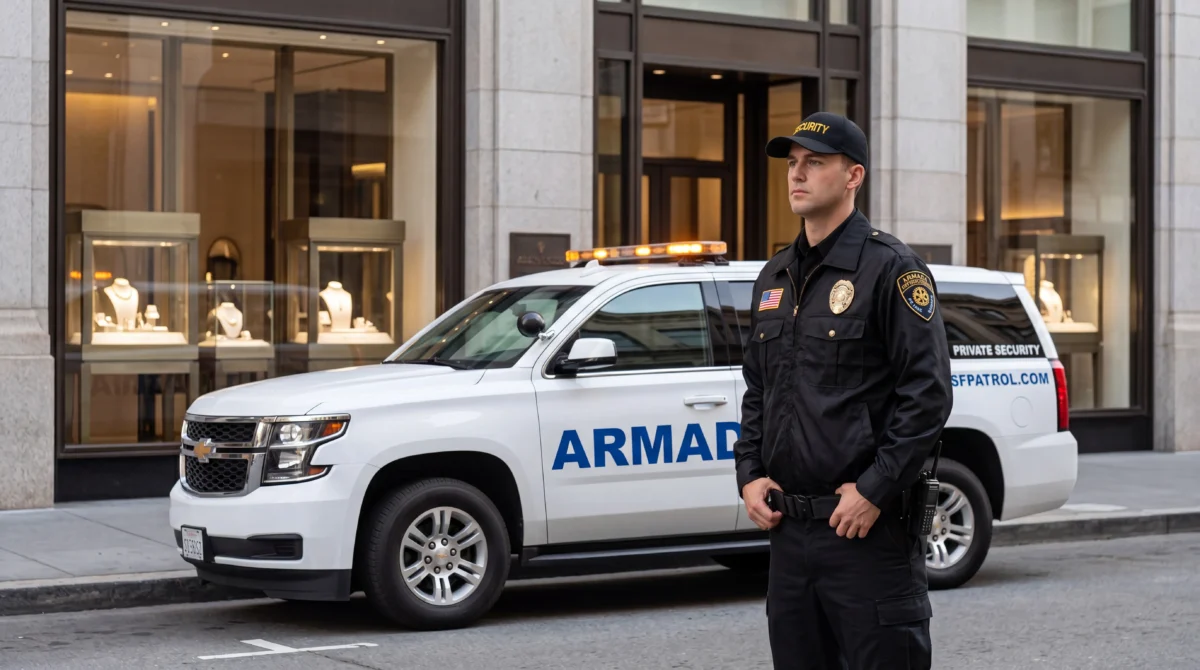
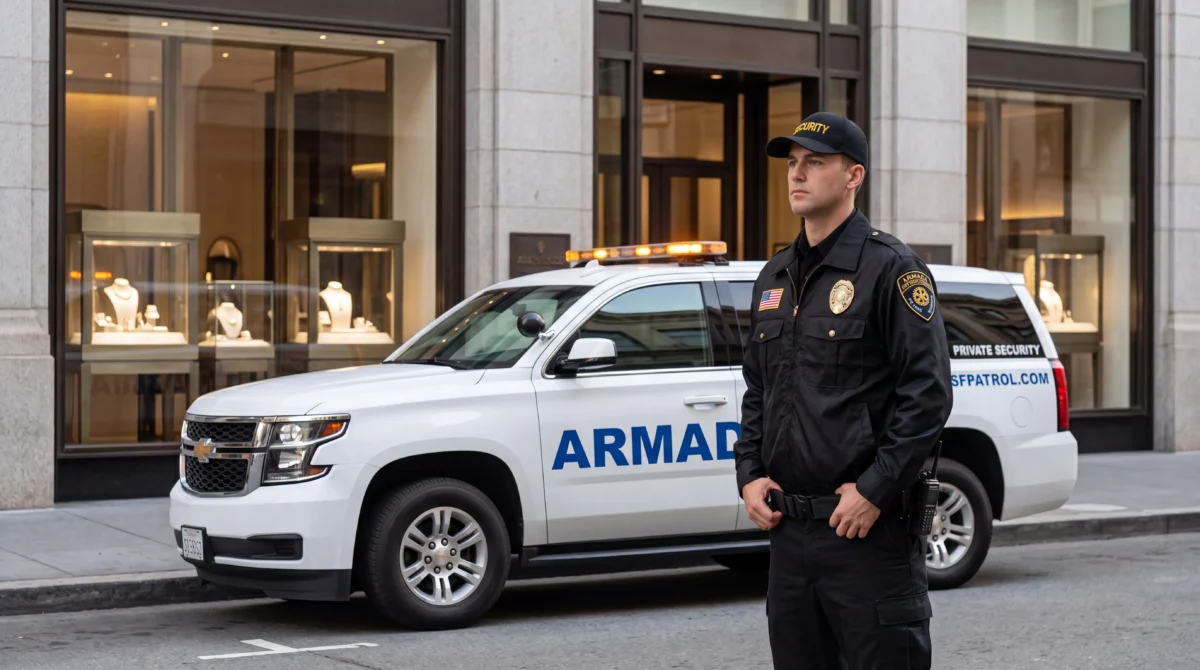
Jewelry store security in San Francisco comes down to four moments: the showroom floor during business hours, the door at opening, the inventory transfer at closing, and the empty building overnight. A program that covers only one of them leaves the other three exposed. Armada Security staffs all four with BSIS-licensed officers (Private Patrol Operator license PPO 120526), armed or unarmed depending on your risk profile. The company has protected Bay Area commercial sites since 1994.
The threat pattern for high-value retail
High-value showrooms are targeted differently from ordinary retail. What our officers train against:
- Coordinated grab-and-run during peak hours, usually with a distraction working the counter.
- Distraction tactics aimed at display cases left unlocked during a consultation.
- After-hours break-ins targeting vaults and backrooms.
- Robbery risk during opening and closing (the moments inventory moves between safe and floor).
- Personal safety of high-net-worth clients arriving for private showings.
Deterrence is the core of the strategy: organized groups pick unguarded targets. Our own operational data across guarded sites shows roughly an 80% deterrence rate: most incidents never start because a uniformed officer is visible at the entrance. And when something does happen, San Francisco reality applies: SFPD deprioritizes minor theft, so the on-site officer responds first, typically about twice as fast as police in our internal data, and then hands off.
What the program includes
- Showroom floor presence: a professional officer on the floor during business hours, positioned near the entrance.
- Opening and closing protocols: exterior inspection before staff enter, watch during inventory transfers, confirmation that staff leave safely at night.
- Access management for private showings: controlled entry during appointment-only hours.
- After-hours protection and alarm response for the building itself.
- Incident documentation: a written report for every shift and every event, delivered to your management.
Patrol activity is GPS-tracked and guard presence is verified through TrackTik, which matters for one specific reason below.
Security that does not break the showroom experience
A luxury showroom cannot feel like a checkpoint. Our officers are trained to work as an extension of your front-of-house: greet visitors, hold the door, stay visible without hovering over clients. The deterrence effect comes from presence and attention, not from posture. Uniform standard is matched to your brand. Business attire posts are available where a traditional uniform is wrong for the space.
Insurance and documentation
Underwriters for high-value inventory (Jewelers Block class policies) commonly require documented security measures as a condition of coverage. This is where verified logs earn their keep: TrackTik-verified guard presence and per-shift written reports give you an evidence trail that coverage conditions were met, useful both at renewal and after a claim. Licensing is verifiable independently: check any provider, including us, in the California BSIS public lookup; our license is PPO 120526.
Coverage and start time
We serve jewelers and high-value retail across San Francisco (Union Square, the Financial District, SoMa, the Marina and adjacent districts) and 11 more cities across the Peninsula and San Jose. New coverage can typically start within 48 hours of a signed agreement; quotes follow a site walk-through, not a rate card, because a two-door Union Square showroom and an appointment-only upstairs atelier need different programs.
For appraisal events, trunk shows and private buying appointments, where a single afternoon can bring more inventory onto the floor than a normal week, staffing scales for the event rather than sitting at the standing daily post count. That is a scheduling call, not a separate service: the same contract simply flexes for the date.
Frequently Asked Questions
What drives the cost of jewelry store security in San Francisco and the Bay Area?
Cost is shaped by site size, post hours, foot traffic, risk level, and how much coverage you need across open, close, and overnight periods. Higher-risk sites may need more trained guards, tighter access control, and more frequent checks. We serve commercial sites across San Francisco, the Peninsula, and San Jose, so the best quote starts with your site map and schedule.
What should a property manager or board ask about liability before hiring a security provider?
Ask for proof of State of California licensing and clear scope for the site, the shift, and the chain of command. Armada Security is licensed by the State of California, BSIS PPO 120526, and we work only with B2B clients such as property managers, corporate sites, and multi-family communities. You should also confirm written post orders, incident reporting, and who is named as the point of contact for your team.
How fast can a Bay Area security team respond when there is an alarm, trespasser, or after-hours issue?
Response time depends on site location, shift coverage, and how close the post is to the incident. The real test is whether the team is already on site, has clear radio or phone reach, and knows who to call at once. For San Francisco and nearby cities like San Mateo, Daly City, and San Bruno, ask for the expected on-site reach for your exact location, not a broad promise.
